Nobody notices when you skip a day. That is the quiet difficulty at the centre of learning an instrument on your own. A missed lesson has a teacher attached to it. A missed rehearsal has a room of people waiting. A missed practice day has nothing — just you, a small flicker of guilt in the evening, and a day that closes over the gap as though it were never there.
The day nobody notices
Almost nobody stops practising in one dramatic decision. They stop one Tuesday, then one Thursday, then a week that got busy, and by the time they notice, the instrument has quietly become furniture. Every one of those days felt reasonable on its own, which is exactly why the drift is so hard to catch: no part of it feels like quitting.
What breaks the drift is smaller than most people expect. Not discipline, not a better practice plan — just the sense that the day is being recorded somewhere outside your own head.
Accountability is a witness, not a judge
Accountability has an unfortunate reputation. It sounds like pressure, deadlines, someone standing over you with a clipboard. In practice it is far gentler than that. All it means is that your effort leaves a mark somewhere you did not invent, and that somebody — even a stranger you will never meet — could in principle see it.
That turns out to be enough. Nobody has to actually check. The mere possibility of being seen shifts behaviour long before any seeing happens, which is why a practice log you keep for yourself is useful, and a practice record that sits alongside other people's is useful in a different way.
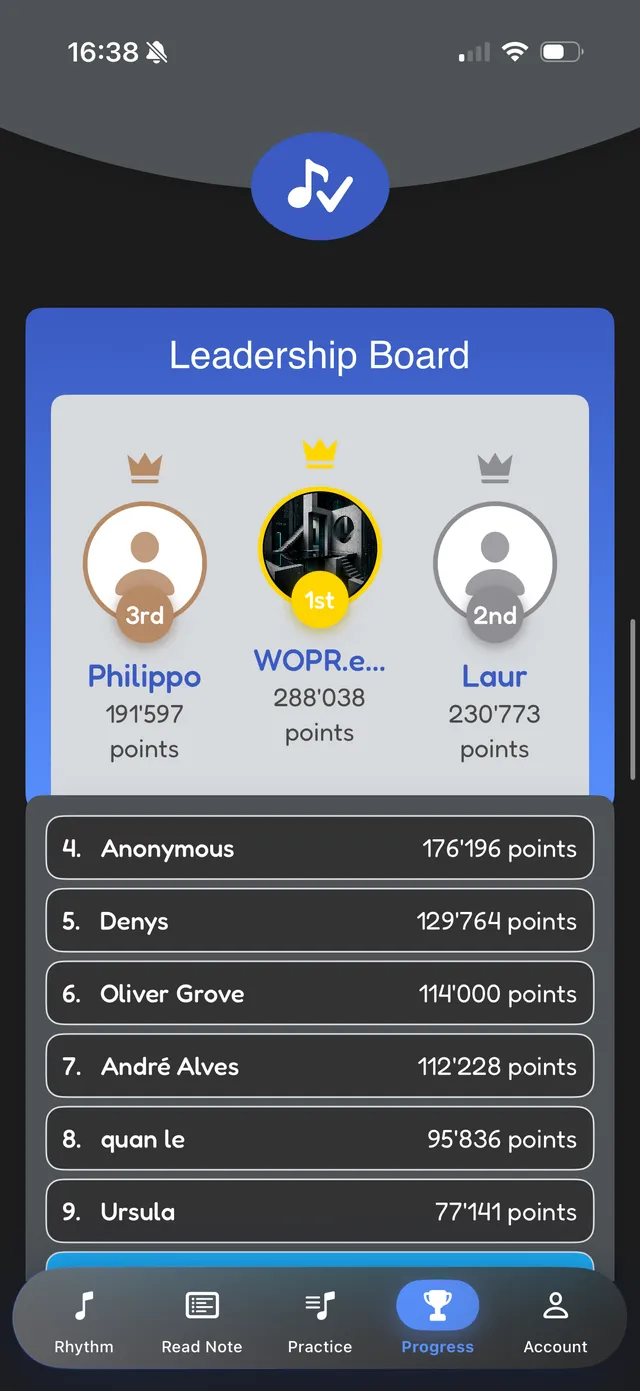
Your profile and the all-time board: the hours you have actually played, kept in plain sight and in company.
Why a visible number changes private behaviour
There is one moment in the day worth paying attention to. It is nine in the evening, you are tired, and you know that fifteen minutes at the instrument makes the day count and that skipping makes it not count. Alone, that moment usually goes badly. With a record attached to it, it goes surprisingly well — not out of fear of judgement, but because you would rather the number be true.
That is the entire mechanism, and it is humbler than it sounds. You are not competing with anyone at nine in the evening. You are simply unwilling to let something real become slightly less real.
The long game is measured in hours, not weeks
Weekly targets are good for momentum and poor for perspective. One week tells you what your calendar looked like, not whether you are becoming a musician. The number that actually answers that question accumulates far too slowly to feel like progress on any given evening — and far too steadily to argue with across a year.
An all-time total is the honest version of your practice history. It cannot be rescued by one heroic Sunday and it cannot be ruined by one bad fortnight. It moves at exactly the pace your playing moves, which makes watching it climb one of the few genuinely reliable forms of encouragement available to someone learning without a teacher.
Compare yourself to the right person
A leaderboard can be held two ways. Held badly, it is a list of people ahead of you, and it will make you feel worse every time you open it. Held well, it is context — evidence that the hours you are logging are the same ordinary hours everyone else is logging, and that nobody near the top arrived there by any route other than showing up repeatedly.
The comparison worth making is nearly always with your own past. Where were you six months ago? What did an average week look like then? Other players are there to make the scale legible, not to set your target. If the top of the board discourages you rather than clarifies things, close it and look at your own history instead — it is the only ranking that actually describes you.
How to make it work for you
Keep the record honest. It is far more valuable when it captures your ordinary weeks than when it only flatters your good ones. Log the short sessions as readily as the long ones, because the fifteen-minute entry is the one that keeps the chain intact. Look at the all-time view rarely — once a month is plenty — and at today's number whenever you finish playing.
And when a week goes badly, resist the urge to tidy it away. The gaps are part of what makes the rest believable. None of this replaces practice; it just removes the one thing that quietly ends most self-taught journeys — the sense that if you stopped, nobody, yourself included, would ever quite notice.
Practice smarter, starting today
Metronome, practice timer, note reading, rhythm training and more — free to download.
Free to download · iPhone, iPad & Android