The gap between knowing and doing
Almost every musician already knows what would make them better: show up most days, work slowly, and give the hard bars more attention than the easy ones. The knowing is rarely the problem. The doing is. On the third busy Tuesday of the month, when the case is zipped shut and the sofa is close, no amount of good advice competes with the pull of doing nothing.
This is where most practice plans quietly fall apart — not because the plan was wrong, but because nothing in the moment rewards you for keeping it. A reward you can see and feel right after a session is one of the few things that reliably tips the decision back toward picking the instrument up.
Why the brain loves a small win
Long-term goals are strange motivators. "Play this piece by spring" is inspiring in January and invisible by February, because the payoff is too far away to feel. Small wins work differently. When effort is followed closely by a marker of progress — a badge earned, a streak that ticks up — the brain quietly files practice under "worth doing again." Repeat that enough times and the habit starts to carry itself.
None of this is a trick to fool yourself into practising. It is closer to giving honest work the acknowledgement it usually never gets. You did the fifteen minutes; something noticed.
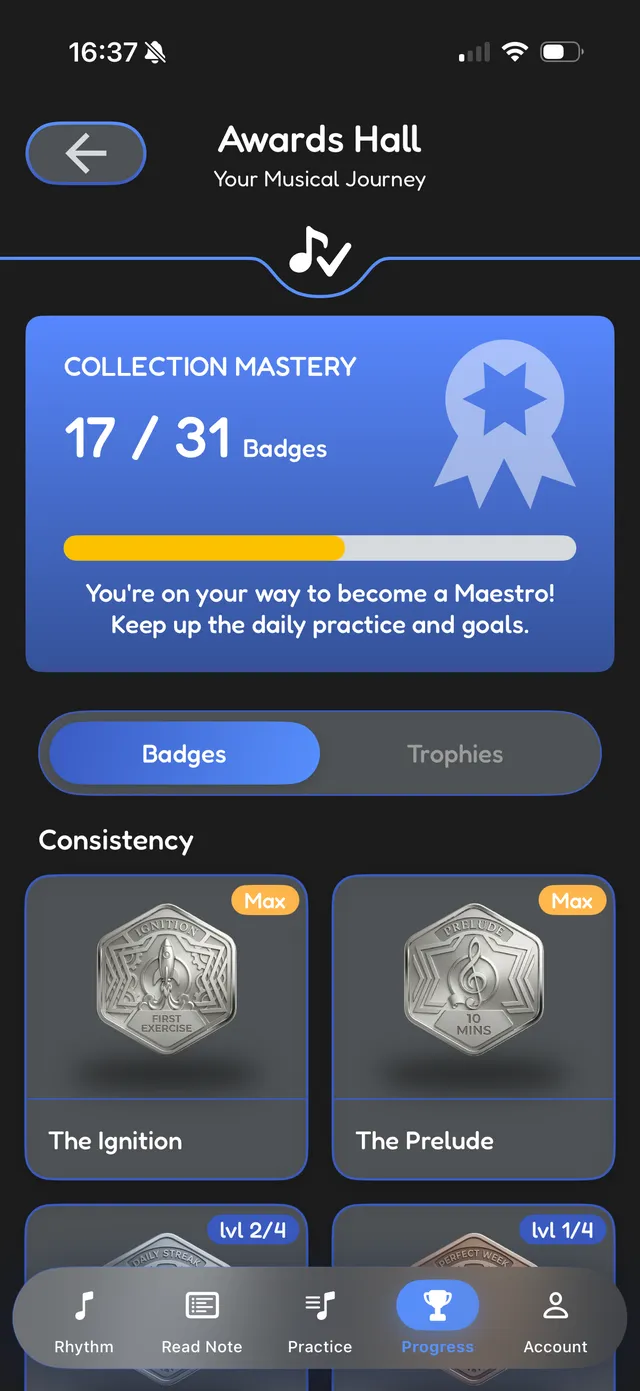
The Awards Hall: 31 badges and 17 trophies that reward the practice you actually do — not the talent you were born with.
What a good reward actually rewards
The detail that matters most is what earns the reward. Badges tied to talent or raw results — play the fastest, score the highest — mostly celebrate what you were already good at. The rewards worth chasing are the ones tied to effort you control: turning up, logging minutes, stringing days together. Those are within reach of a rank beginner and a conservatory student alike, and they point at the exact behaviour that produces real improvement.
Go Practice Music's Awards Hall is built around that idea. Its badges and trophies mark the practice you actually did — sessions completed, hours accumulated, streaks defended — not how gifted you happen to be.
Badges for the milestones, trophies for the streaks
Two kinds of reward do two different jobs. Badges mark milestones you cross once: your first recorded session, your tenth logged hour, your first full week without a gap. They are the breadcrumbs that show a beginning turning into a practice. Trophies reward the harder thing — consistency held over time — and they raise the stakes just enough that you think twice before letting a streak lapse.
With 31 badges and 17 trophies to uncover, there is almost always a next one within reach. That matters most on the low days: when motivation is gone, "I'm two sessions from that badge" is often just enough to get the case open.
How to use them without gaming yourself
Rewards can backfire if you start practising for the badge instead of the music. A simple guard: let the awards follow good practice, never define it. Keep your real goal in front of you — the piece, the passage, the sound you are after — and treat the badge as a nod for having shown up, not the reason you did. Used that way, a reward serves the habit instead of standing in for it.
It also helps to glance at the Awards Hall on the days you least feel like practising, rather than the days you are already keen. That is when a visible, nearly-earned reward does its best work.
The reward that lasts
Eventually the badges become beside the point. The real prize is the version of you who practises without needing to be talked into it, for whom picking up the instrument is simply what you do. Short-term rewards are the scaffolding that holds a habit up while it is still fragile. Keep showing up, let the small wins accumulate, and one day you will notice the scaffolding is no longer holding anything up. The habit is standing on its own.
Practice smarter, starting today
Metronome, practice timer, note reading, rhythm training and more — free to download.
Free to download · iPhone, iPad & Android