Almost everyone who picks up an instrument imagines the same scene: a year from now, sitting down and playing something real. Most never get there. The numbers vary by instrument and by teacher, but the shape is always the same — a large share of adult beginners stop within the first twelve months, and the steepest drop happens much earlier than that.
What is striking is how little of it has to do with talent. The people who quit are rarely the ones without an ear or without hands. They are the ones who walked into a completely normal stage of learning and read it as a verdict. This is about that stage, why it fools so many players, and the few habits that separate the person still playing in year three from the person with an instrument in a cupboard.
The wall arrives roughly on schedule
The first weeks are wonderful. Every session hands you something visibly new: your first chord change, your first scale, the first time both hands do different things at once. Progress is loud, and it is free.
Then, somewhere between month two and month six, it goes quiet. You are no longer collecting firsts; you are grinding away at coordination, tone and timing. The gains are still there, but they have become smaller than a single session can show. Almost everyone who quits, quits here — in the flat stretch, convinced the flatness says something about them.
Your ear improves faster than your hands
Musicians carry an odd disadvantage: taste develops faster than technique. Within a few months you can hear exactly how far your playing sits from the recording you love, and that distance feels like it is growing. It is not. Your standards are simply climbing faster than your fingers — which is progress wearing the costume of failure.
Add the internet, where a fourteen-year-old plays the piece flawlessly with no mention of the six years behind it, and the discouragement gets a permanent supply line. You are comparing your month four to somebody else's year seven, and you are not being told the difference.
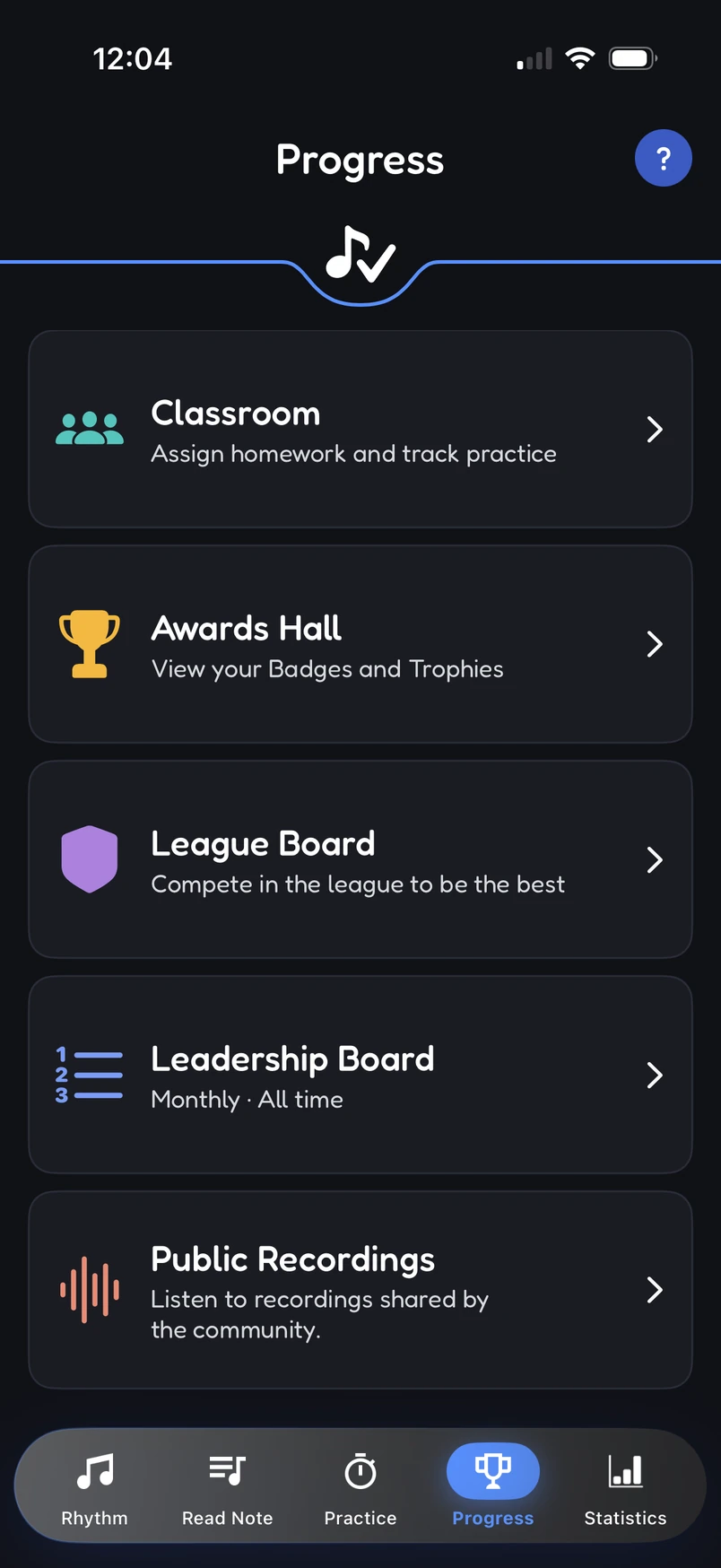
The progress screen in Go Practice Music keeps the long view visible: your streak, your lifetime hours, and where they sit on the road to 5,000.
Day to day, progress is invisible — over months, it is obvious
Memory is a bad witness to your own improvement. It quietly rewrites the past to match the present, so the version of you from three months ago always seems roughly as good as today. That is why the honest question — "am I actually getting better?" — so often gets answered with a shrug and a wince.
A record settles it. Logged hours, a streak, a list of pieces with time against each: none of that is motivational decoration. It is evidence, and it is the only thing that reliably beats a bad day's self-assessment. When the session feels pointless, the number does not care how it felt — it just shows the work.
Make the timescale honest
Part of what breaks beginners is a private, unexamined schedule: I should be good by now. Almost nobody says it out loud, and almost everybody carries it.
So look at the real numbers. Serious players accumulate thousands of hours — the often-quoted 5,000-hour benchmark is roughly an hour a day for well over a decade. That figure sounds deflating for about ten seconds, and then it becomes the most freeing thing in music. At twenty minutes a day you are not failing at your instrument in month four. You are a hundred-odd hours into a very long, very good project, and behaving exactly as expected. The progress screen in Go Practice Music shows your lifetime hours against that benchmark for precisely this reason: not to shame the total, but to make the scale honest.
What the players who stay actually do
They practise small and often — fifteen honest minutes most days rather than three heroic hours once a fortnight. They never miss twice in a row, treating one skipped day as weather and two as a decision. They keep one piece they can already play, so every session contains something that sounds like music rather than only work. And they learn at least one thing purely because they love it, which is the fuel nothing else replaces.
Above all, they keep score. Not to compete with anyone, but so that the flat stretch has a counter-argument. A streak worth protecting is a small, slightly silly thing that gets you to the instrument on the evening you would otherwise have skipped — and the evenings you would otherwise have skipped are, in the end, the whole game.
The plateau is not the end of the road
If your playing feels stuck right now, the most likely explanation is not that you lack talent. It is that you have arrived, on schedule, at the ordinary middle of learning an instrument — the part nobody photographs and everybody has to walk through.
Shrink the daily session until it is too small to skip. Start the timer. Let the hours pile up somewhere you can see them. Come back in six months and read the number, not the mood. The people still playing in year three are not the talented ones. They are the ones who did not quit in month four.
Practice smarter, starting today
Metronome, practice timer, note reading, rhythm training and more — free to download.
Free to download · iPhone, iPad & Android