Ask a player what they are working on and you usually get a pause, then two titles: the piece they opened yesterday, and the one they have been half-learning since spring. Everything else has quietly slid off the desk. That is not laziness. Without a written list, your repertoire is simply whatever your hands happened to reach for this week.
The piece you did not play is the piece you are losing
Music fades politely. A piece you played fluently in March does not announce that it is slipping; it just gets a little slower to start, a little less certain in the middle section. Six weeks later you sit down to play it for someone and discover it is gone — not entirely, but enough to be embarrassing.
The frustrating part is how little it would have taken to keep it. Five minutes a week is usually enough to hold a learned piece in place. But you cannot spend five minutes on something you have forgotten you know.
A repertoire is a decision, not an inventory
Writing your pieces down sounds like bookkeeping. It is actually the opposite: it forces a choice. Once the list exists, you have to look at it and decide what stays, what gets finished, and what you are quietly allowed to abandon.
That last permission matters more than people expect. Most players are carrying two or three pieces out of guilt — started with enthusiasm, stalled at a hard page, never formally dropped. They take up no practice time but a surprising amount of mental space. Crossing one off is a genuine relief.
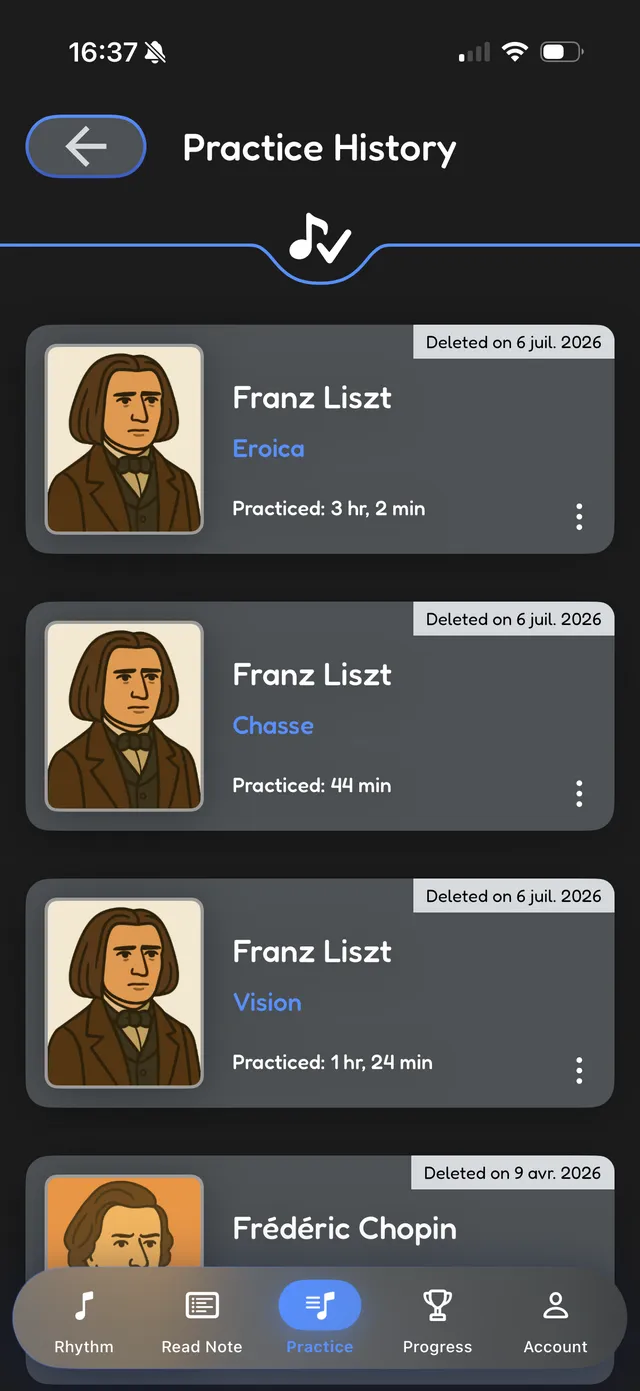
Every piece on its own line, with the hours you have actually given it.
Hours per piece tell you the truth
The moment a repertoire list gets interesting is when you attach time to it. Not a rating, not a percentage — just the hours you have actually spent on each piece.
The numbers are almost always surprising. The piece you think of as your main project turns out to have eleven hours on it; the study you consider a chore has twenty-six. You learn that the hard passage you have been avoiding has received nine minutes of attention in a month, which explains a great deal about why it is still hard.
In Go Practice Music, every session is logged against the piece you were playing, so the hours accumulate without you doing anything. Over a few weeks the list stops being a plan and becomes a record — an honest one.
Three shelves: learning, polishing, keeping
A useful repertoire is sorted, not just listed. Three groups are enough.
Learning is where the real work happens: one or two pieces, no more. These get the bulk of your session and all of your slow, careful attention. Polishing holds pieces you can play through but would not yet perform — they need tempo, evenness, confidence at the seams. Keeping is your performable repertoire: pieces you can sit down and play. These need maintenance, not work, and a single run-through each week is often enough.
The imbalance most players discover is that their Learning shelf has five pieces on it and their Keeping shelf has none. That is the shape of practice that always feels busy and never feels finished.
How to build yours this week
Sit down with your instrument and write out everything you can currently play, or nearly play, without looking anything up. Ten minutes, no editing. Then add the pieces you are actively learning, and the ones you meant to learn and never started.
Now sort them onto the three shelves and be ruthless about the Learning shelf: pick two. The rest are not gone, they are just waiting. Finally, put one piece on the Keeping shelf even if it is something simple you learned years ago. Having something you can play on request, without preparation, changes how you feel about your own playing more than any technical gain.
What changes after a month
Not much, at first. Then you notice you have stopped opening the same two pieces by reflex, because the list is there and it has opinions. You notice that finished pieces are staying finished, because five minutes on the Keeping shelf is easy to fit in. And you notice that when someone asks what you are working on, you have an answer.
That is a small thing, but it points at something larger. A repertoire is the evidence that your practice is going somewhere — not just hours logged, but pieces you can actually play, written down where you can see them accumulate.
Practice smarter, starting today
Metronome, practice timer, note reading, rhythm training and more — free to download.
Free to download · iPhone, iPad & Android