Ask a room of adult learners why they stopped playing, and almost nobody says they lost interest. They say life got busy. The practice didn't collapse because the love of music faded — it collapsed because it depended on motivation, and motivation is the least reliable resource a musician has.
Motivation is a terrible scheduler
Motivation surges after a great lesson, an inspiring concert, a recording that gives you chills. It drains after a long workday, a short night, a week of small frustrations. You can't control when it shows up, which means any practice plan built on it inherits its mood swings. A habit works the other way round: you decide once, and then repetition does the deciding for you. Nobody negotiates with themselves about brushing their teeth.
This matters because in skill learning, frequency beats volume. Six days of twenty focused minutes builds more technique and retention than one heroic two-hour Sunday, because your brain consolidates motor learning between sessions — much of the progress literally happens while you sleep. A daily habit isn't just easier to keep than bursts of enthusiasm; it's better practice.
Make the session too small to skip
The most common mistake is defining a session so ambitious that your tired evening self vetoes it. If practice means an hour of scales, repertoire and etudes, then on a busy day the honest answer is no. So shrink the commitment until refusing feels silly: ten minutes. One passage. Even just opening the case and playing something you love.
Small sessions have a quiet superpower: once you're seated with the instrument in your hands, you'll often keep going. But the habit is measured by showing up, not by the clock. On the days you stop at ten minutes, the habit still won — because tomorrow it will get you seated again.
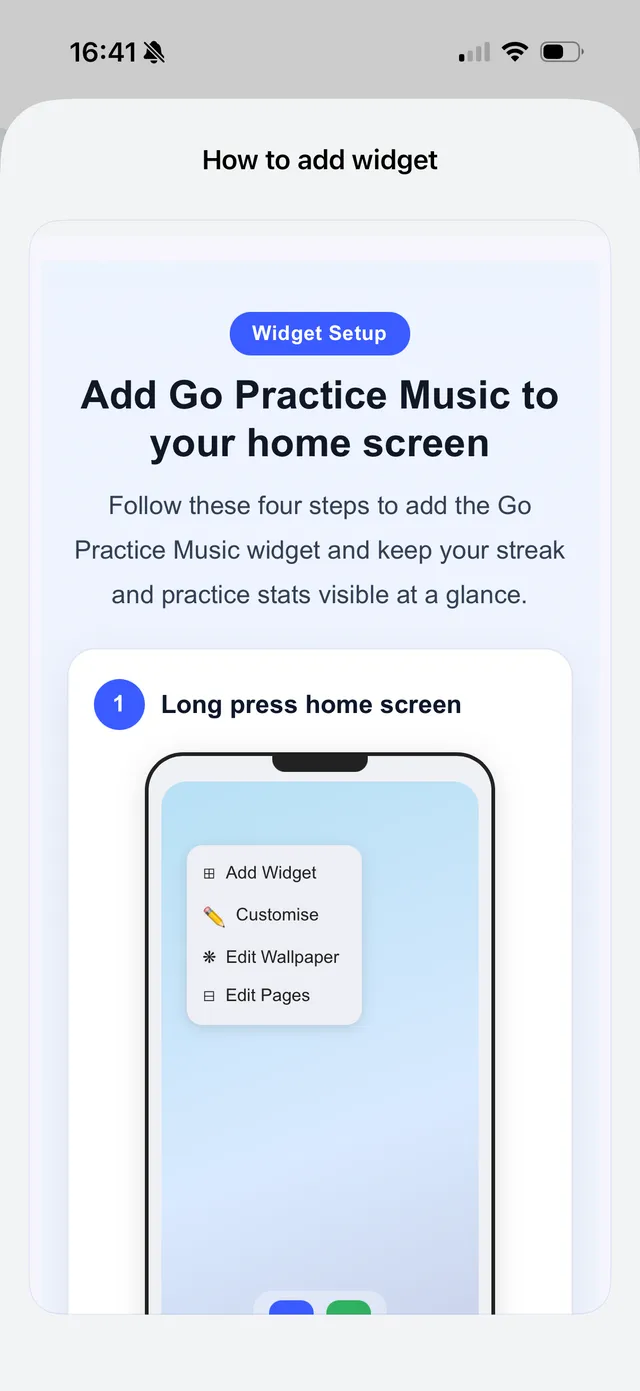
The home-screen widget keeps your streak and today's minutes in sight — a practice cue you see every time you pick up your phone.
Give the habit a cue it can't ignore
Habits run on cues: something you see or do that triggers the routine without a decision. The strongest cue most of us own is the phone we unlock dozens of times a day. That's the thinking behind the Go Practice home-screen widget — your current streak and today's minutes sit right on the home screen, so every unlock quietly asks the same question: have you played yet today? No notification, no guilt trip, just a visible score that's either ticking or waiting.
Anchor it to something you already do
The second-best cue is a routine you already never skip. Habit researchers call it stacking: after the morning coffee, before the evening news, right after the kids are in bed — attach practice to an anchor and the day's structure does the remembering. It also helps to cut setup friction to near zero. A guitar on a stand gets played; a guitar in a case in a cupboard gets remembered fondly. Same chair, same time, instrument in reach: you're not relying on discipline, you're removing the need for it.
Never miss twice
Some day, life will win. A trip, an illness, a deadline — the streak breaks, and this is the moment that decides everything. One missed day is noise. Two missed days are the beginning of a different habit: the habit of not practicing. So borrow the simplest rule in behavior change: never miss twice. The day after a miss isn't a failure to mourn, it's the most important practice day of your month — even if it's five minutes.
Let the system carry you on the gray days
On inspired days, none of this matters; you'd have played anyway. The habit exists for the gray days — the tired, unremarkable evenings that make up most of a life. If a small session, a visible cue and a never-miss-twice rule get you through those, the arithmetic becomes unstoppable: twenty minutes a day is over 120 hours a year, logged one unglamorous evening at a time. Months from now, the streak on your home screen won't just be a number. It will be proof that you've become the kind of musician who plays every day — which is the only kind that keeps getting better.
Practice smarter, starting today
Metronome, practice timer, note reading, rhythm training and more — free to download.
Free to download · iPhone, iPad & Android