Ask a room of amateur musicians what they should be doing differently and most of them can answer straight away. Practise slower. Use the metronome. Stop starting from the top every time. The information is rarely the problem — the moment is. Advice you read six months ago in a book you have since shelved does not reach you at seven in the evening on a Tuesday, case open, twenty minutes to spare.
You already know more than you use
Most of us carry around a sizeable pile of good advice we have never acted on. It arrived all at once — in a lesson, in a video, in a chapter on efficient practice — and it stayed roughly where it landed. Knowledge that never turns into a habit is decoration.
The gap is not intelligence or discipline. It is that a lot of advice at once is hard to hold. Twelve principles of good practice, read in one sitting, compress into a vague feeling that you ought to be more disciplined. That feeling has never helped anybody play better.
A tip only works if it arrives in time
Something changes when the same idea shows up on the day you are about to practise. It stops being theory. If you open the app and read play the passage at half speed and listen to the joins, you are three seconds away from doing it. Nothing to remember, nothing to schedule. The advice and the opportunity have finally met.
That is why the practice tip sits on the home screen and changes every day, rather than living in a library buried in a menu. You are not meant to study it. You are meant to bump into it on your way to the instrument.
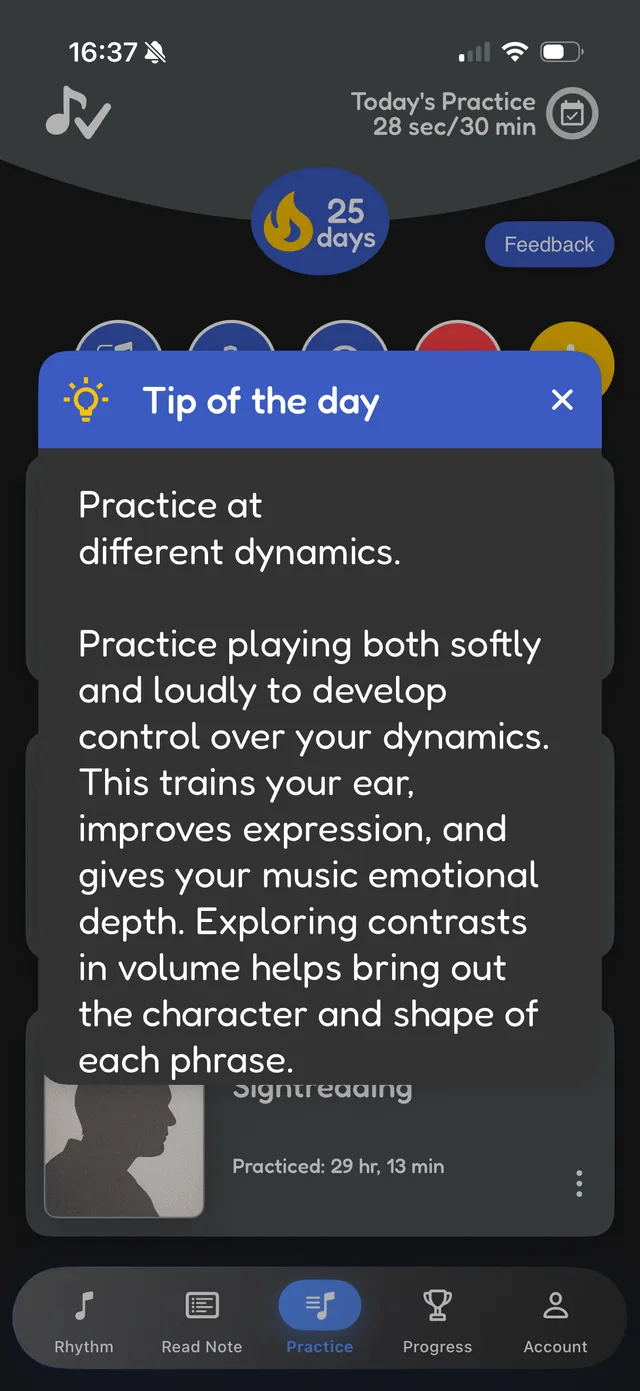
A fresh practice tip waiting on the home screen — small enough to try before you have finished tuning.
One idea is small enough to actually try
A single tip has a useful property: it fits. You can apply it to whatever you are already working on, today, without redesigning your routine. Slow one bar down. Play the phrase with your eyes shut. Record thirty seconds and listen back. Count a line out loud. None of these ask you to become a different musician by Friday.
And because it costs so little, you will actually do it — which is the only way a technique becomes yours. Ideas you have tried once stay available to you for good. Ideas you have only read stay theoretical no matter how often you nod at them.
Variety keeps you honest
Left to ourselves, we all practise the way we enjoy practising. Guitarists drift toward the parts that already sound good. Pianists loop the passage they have nearly mastered. Everyone avoids the tempo where the cracks show. A rotating tip is a mild, friendly interruption to that comfort: some days it points at rhythm, some days at tone, some days at what you do with the first five minutes.
You will not use every one, and you should not try to. The value is in the nudge sideways — the reminder that there is more than one way into a piece.
How to use a daily tip well
Read it before you start, not afterwards. Take one thing from it and apply it to a single passage rather than the whole session. Give it a fair trial — a few minutes, not thirty seconds. And if it clearly does not suit today, let it go without guilt. There is another one tomorrow.
When a tip lands well, note it in your practice log beside the piece it helped. Over a few months you build a short, personal list of things that reliably work for you, which is worth a great deal more than a shelf of general advice.
Small inputs, compounded
None of this is dramatic. One tip will not transform your playing, and anything promising otherwise is selling you something. But a daily prompt that costs ten seconds to read and occasionally reshapes twenty minutes of practice is an excellent trade. Do it for a year and the compound effect is not the tips themselves — it is a practice habit that keeps getting slightly smarter.
Practice smarter, starting today
Metronome, practice timer, note reading, rhythm training and more — free to download.
Free to download · iPhone, iPad & Android