You sit down, open the music, and play. Forty minutes later you close the lid, mildly satisfied: you practised today. But if someone asked what you fixed, you would struggle to answer. You played the piece from the top three times, stumbled in the same two places each time, and carried on regardless.
This is how most practice time is spent, and it is why so many players plateau for years while still putting in the hours. The difference between musicians who keep improving and musicians who merely keep playing is rarely talent, and it is rarely time. It is attention.
Playing is not the same as practising
Playing through a piece feels productive because it produces music. Something recognisable comes out of the instrument, the time passes pleasantly, and the log says forty minutes. But a run-through mostly rehearses the piece exactly as it already is — including the parts you cannot yet do.
Real practice sounds different. It is two bars, over and over. It is one hand alone. It is stopping mid-phrase because something was not right. It is not enjoyable in the way playing is, and it is not something anyone would choose to listen to. That is roughly the sound of getting better.
What makes practice deliberate
Researchers who study how experts are made describe deliberate practice with four features, and every one of them is available to an amateur on a Tuesday evening.
There is a specific target — not “the sonata” but “the left-hand leap in bar 34”. The task sits just beyond what you can currently do: hard enough to demand your full attention, close enough that you can succeed within one session. There is immediate feedback, so you know after each attempt whether it worked. And there is repetition with correction, rather than repetition with hope.
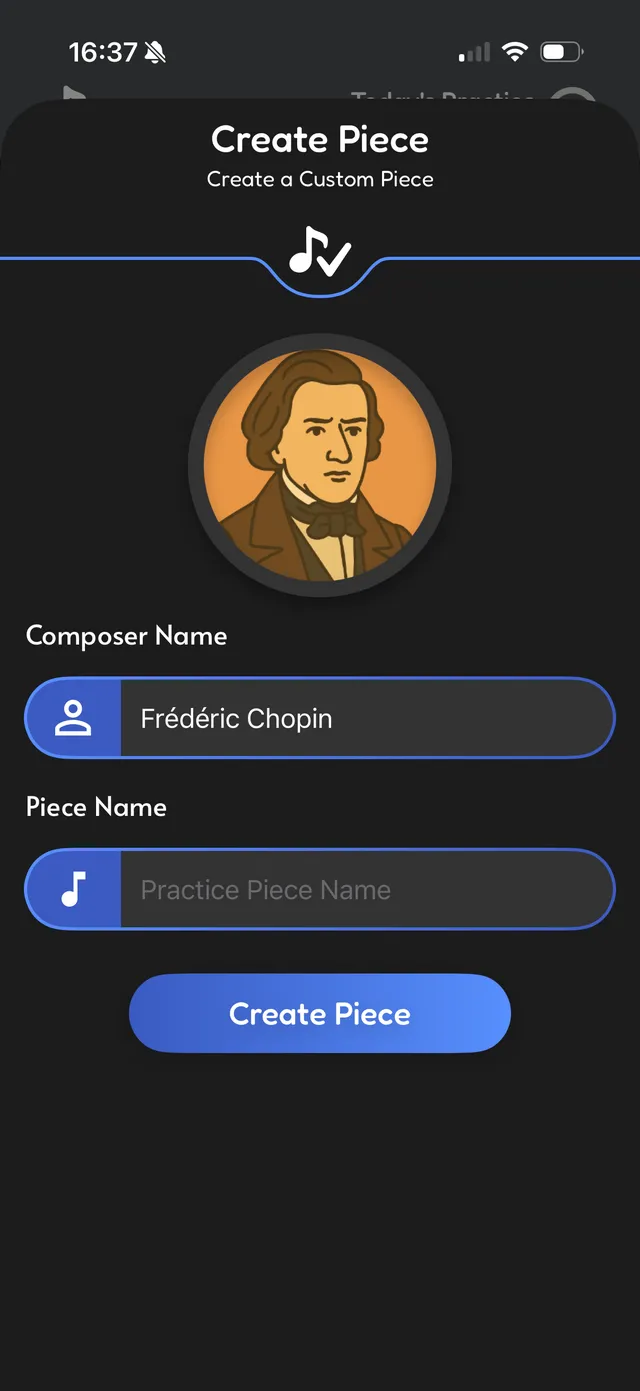
Practice history in Go Practice Music: every session logged against a specific piece, so you can see exactly where your attention has been going.
Shrink the unit of practice
The single most useful change most players can make is to work on something smaller. Instead of the movement, the page. Instead of the page, the phrase. Instead of the phrase, the bar. Instead of the bar, the one transition between two notes that keeps collapsing.
Small targets are what make feedback possible in the first place. You can hear a single bar clearly and judge it honestly; a whole page goes by too fast to evaluate. A small target is also winnable — you can finish a session having actually solved something, which is a far better feeling than having played for an hour and improved nothing.
Attention is the resource that runs out
Deliberate practice is expensive in concentration rather than in minutes. Most adults manage somewhere between twenty and forty minutes of real focus before quality quietly drops and the hands take over.
If your life is busy, this is good news: ten attentive minutes are worth more than an hour on autopilot. It also means that practising while tired, distracted or half-watching something is not a cheaper version of practice. It is a different activity, and it does not compound.
Keep an honest record of what you worked on
Deliberate practice depends on knowing where you have already been, and memory is a poor witness. Left to itself, practice drifts towards whatever is comfortable: the pieces that already sound good collect the hours, while the piece with the difficult page quietly collects none.
Go Practice Music keeps a practice history for every piece in your repertoire — the sessions, the dates and the hours logged against each one. It takes about ten seconds to see that one piece has had four hours this month and another has had eleven minutes. That is uncomfortable in the useful way, and it makes the next decision obvious.
Leave a note for tomorrow
End each session by deciding one thing: what you will start with next time. Bar 34, hands separately, slowly. Written down, that sentence removes the most wasteful part of practice — the first ten minutes spent deciding what to practise, which usually resolve into playing the piece from the top again.
Nobody improves by accident. Choose one bar. Play it slowly enough to be correct. Listen to what actually happened. Fix one thing, and log the session against the piece so that tomorrow's version of you knows where you left off. That is a complete, honest practice session, and it fits inside ten minutes.
Practice smarter, starting today
Metronome, practice timer, note reading, rhythm training and more — free to download.
Free to download · iPhone, iPad & Android