Ask ten musicians what separates confident players from hesitant ones, and dexterity is rarely the answer. The real difference happens in the half-second before a note sounds: confident musicians hear it coming. That skill, recognizing pitch, interval, and key by ear, is trainable in exactly the same deliberate way rhythm and reading are, and it rewards even a few focused minutes a day.
The skill hiding behind every other skill
Sight-reading, improvising, tuning an instrument, playing in tune with a group, all of it leans on the ear before it leans on the fingers. A player who can hear an interval or sense when a chord wants to resolve is catching mistakes before they happen, not cleaning them up afterward. Everyone practices technique. Almost nobody practices the thing technique is supposed to serve.
The ear doesn't just judge the music. It directs it.
"A good ear" is built, not born
Perfect pitch, naming a note with no reference, is rare and mostly innate. Relative pitch, hearing the distance between two notes and naming it, is a completely different skill, and it's learnable by anyone who repeats the right small exercises often enough. Conservatory ear-training classes exist because this is treated as a craft, not a gift: interval recognition, chord quality, key identification, all drilled the same way scales are drilled.
Passive listening doesn't build this. Structured, active guessing does: hear two notes, name the gap, get told immediately whether you were right.
Why key signatures are the map
A key signature on the page is a set of sharps or flats. A key signature in your ear is something bigger: a gravitational center that every other note in the piece pulls toward or away from. Once your ear recognizes that pull, the sound of "home" in C major versus the sound of "home" in E-flat major, sight-reading gets faster, transposing stops being arithmetic, and improvising over a chord progression stops being a guessing game.
Learning all twelve major keys by ear, not just by their key signature on paper, is one of the highest-leverage habits a developing musician can build.
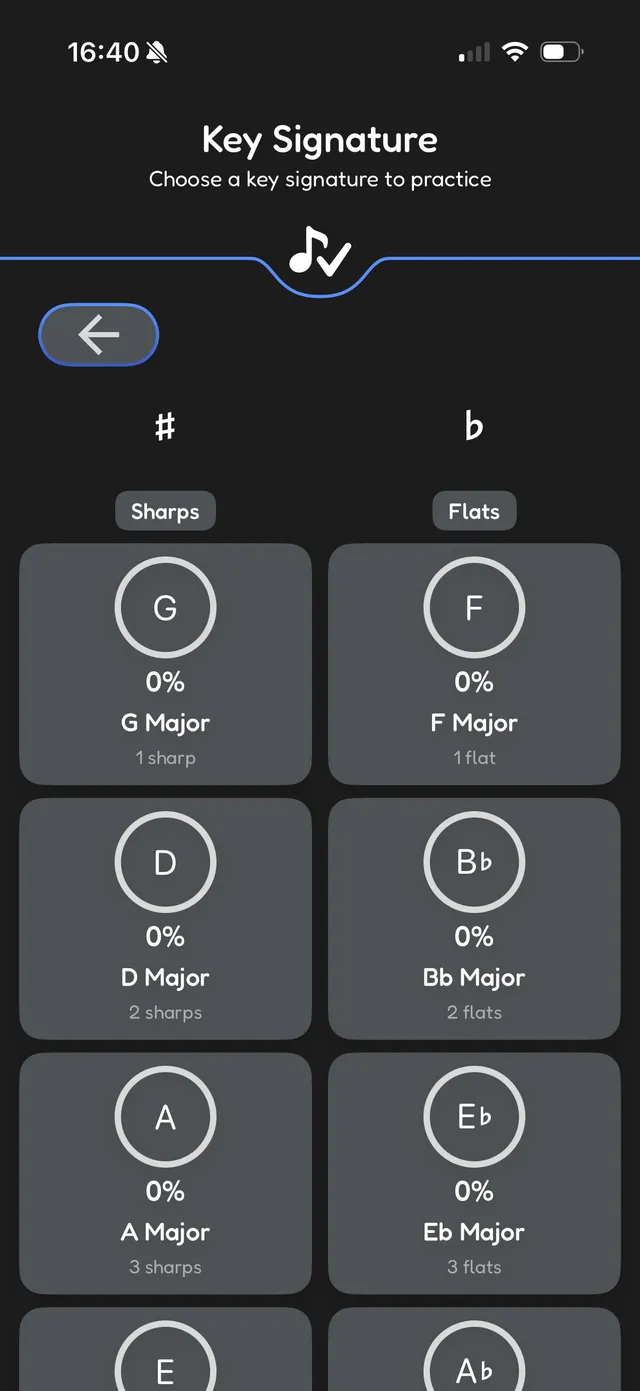
Interval and key-signature drills, each building on the last.
Interval by interval, not all at once
The intervals that are easiest to hear, the octave, the perfect fifth, come first. The ones that are genuinely difficult, like a major second next to a minor second, or a tritone hiding inside a dominant chord, come only once the easy ones are automatic. Skipping ahead doesn't save time; it just means guessing instead of hearing, which trains nothing.
This is why short, graded, daily repetition beats an occasional long session. Five focused minutes of correctly leveled drills teach the ear more than forty minutes of exercises that are either too easy to matter or too hard to follow.
From the practice room to the stage
None of this stays theoretical for long. A trained ear tunes an instrument faster and more accurately than a tuner app used blindly. It transcribes a riff off a recording instead of hunting for tabs online. It catches the one player in an ensemble who's drifted flat, often before they've noticed themselves. And when it's time to improvise, a trained ear already knows what a note is going to sound like before the finger commits to it, which is the entire difference between playing scales and making music.
Frequently asked questions
How long does ear training take to show results?
Most learners notice a real difference within a few weeks of daily, focused practice: recognizing intervals faster, catching wrong notes sooner, feeling more confident finding a key by ear. Like any skill, the gains compound: five minutes a day beats an hour once a month.
Do I need natural talent to have a good ear?
No. Relative pitch, the skill behind almost everything musicians mean by "a good ear," is trainable through consistent, structured repetition. Perfect pitch is rare and mostly innate, but it isn't what makes musicians sound confident. Relative pitch is, and it's available to anyone willing to practice it.
Practice smarter, starting today
Metronome, practice timer, note reading, rhythm training and more — free to download.
Free to download · iPhone, iPad & Android