Most practice advice is about how to begin: warm up, set a target, start slowly. Almost none of it is about how to stop. Yet think back over the last week. The sessions you remember fondly and the ones you would rather forget are mostly separated by one thing — not how long they were, or even how well they went in the middle, but what happened in the final few minutes. A session that ends with a passage finally holding together feels like progress. The same session, ended two minutes later on a run that fell apart, feels like a wasted evening. Nothing about the work changed. Only the ending did.
Your memory of a session is written at the end
People do not remember experiences as an average of every minute. We remember the most intense moment and the last one, and we let those two stand in for the whole. Psychologists call this the peak-end effect, and it applies to practice as surely as it applies to holidays or dentist appointments. If the last thing you did at the instrument was fumble the coda for the sixth time, that is the feeling you carry away — and, more importantly, the feeling that greets you the next day when you consider sitting down again.
This matters because the hardest part of practice is rarely the practice itself. It is the return. A player who finishes on a small, real success has quietly made tomorrow's decision easier. A player who finishes in frustration has made it harder, without ever intending to.
What “ending on a win” actually means
It does not mean flattering yourself. Playing an easy piece you learned years ago as a reward is pleasant, but it teaches nothing and fools no one. A real win is something you could not do at the start of the session and can do — slowly, carefully, cleanly — at the end. Four bars at half tempo, with the right fingering and no hesitation, counts. A single awkward shift landed three times in a row counts. The scale is not important; the honesty is.
The rule of thumb is simple: the last repetition of the day should be a correct one. If the passage is still breaking, drop the tempo until it holds, play it once well, and stop there. You are not being soft on yourself. You are choosing what your hands and your memory take into the night.
Stop while it is still going well
There is a strong temptation, once something finally works, to push it. One more time, a little faster, now the whole page. Very often that is exactly when it collapses — you are tired, your attention has thinned, and the version that just worked was the last clean one you had in you. Ending on the collapse erases the win you had a moment earlier.
Experienced players learn to recognise that moment and leave. Stopping the timer on a good repetition rather than a bad one is a habit worth building deliberately. It feels unnatural at first. It also means you walk away from the instrument wanting to come back, which is a far better place to be than walking away relieved that it is over.
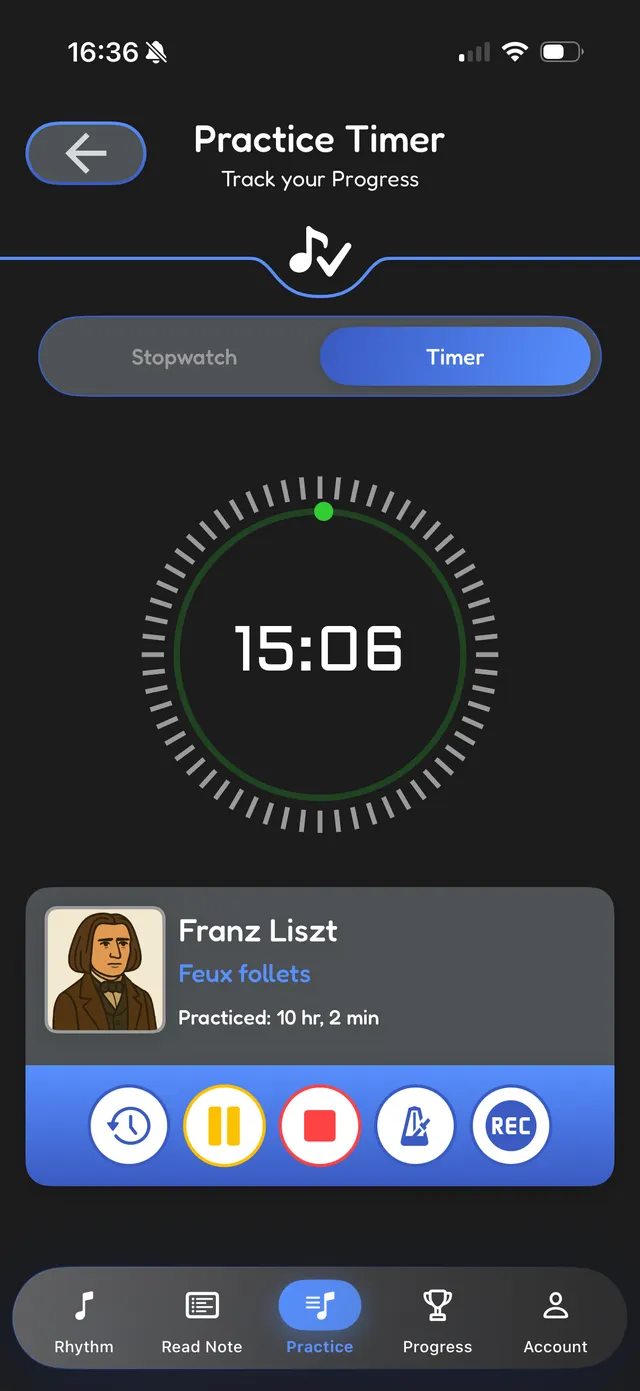
Stop the timer on a clean repetition, not a broken one — the session is logged against the piece, and tomorrow starts where today ended.
Leave yourself a note for tomorrow
The other thing the last five minutes are for is handing over to the person who will practise next — which is you, tomorrow, with no memory of what you discovered today. Which bar was the real problem? What fingering finally worked? What tempo did it hold at? These details evaporate overnight unless you write them down, and rediscovering them costs the first ten minutes of the next session.
One line is enough. “Bars 17–20, left hand, 60 bpm, keep the thumb light.” Log the session against the piece in Go Practice so the minutes are recorded, and keep that line where you will see it first tomorrow — so the next session begins where this one ended, not from the top of the page. Over weeks, those lines become a record of how a piece was actually learned, far more useful than a bare total of hours.
Make the close a ritual
Rituals work because they remove decisions. A five-minute close might look like this: play the day's target passage once, slowly and correctly; play something you love for a minute, just to remember why you do this; write one line about what to do next; stop the timer. That is all. It takes less time than tuning, and it changes the shape of every session you do.
What it gives you is not dramatic. You will not play better tomorrow because you ended well today. But you will be far more likely to play at all — and a session that happens beats, every time, a longer session that was avoided because the last one ended badly. Practise well; then, just as carefully, stop well.
Practice smarter, starting today
Metronome, practice timer, note reading, rhythm training and more — free to download.
Free to download · iPhone, iPad & Android