You know the session. One piece, forty minutes, the same eight bars until they finally behave. You close the instrument satisfied — and by the next morning the passage has quietly come undone again. Nothing was wrong with your effort. What failed was the layout of the session: repeating one thing until it feels solid is the most natural way to practise, and one of the least durable.
Drilling one thing feels like progress — briefly
Practice science calls it blocked practice: staying on one piece or passage and repeating it until it improves. And it does improve — by the tenth repetition the passage runs noticeably better than on the first, and your brain reads that curve as learning. But part of what you are watching is not learning at all. Your hands are warm, the context never changes, and by repetition six you are no longer retrieving the passage from memory — you are riding the momentum of the previous five. The polish you hear at minute forty is partly a performance effect, which is why so much of it has evaporated by tomorrow.
What interleaving is — and why it feels worse
Interleaving is the unglamorous alternative: instead of finishing one thing before starting the next, you rotate. Ten minutes on the Bach, ten on the new piece, ten on scales — then back to the Bach. Every return forces a small act of reconstruction: your fingers have to find the tempo again, your ear the sound you wanted, your memory the fingering you settled on twenty minutes ago. That reconstruction is mildly uncomfortable, and it is exactly the work that makes the material stick.
The catch is that interleaving feels worse while you do it. Each switch throws away the warm-up you had built, the passage runs a little rougher on every return, and the session never delivers that satisfying final run-through. Players abandon the method not because it fails, but because it hides its success until the next day.
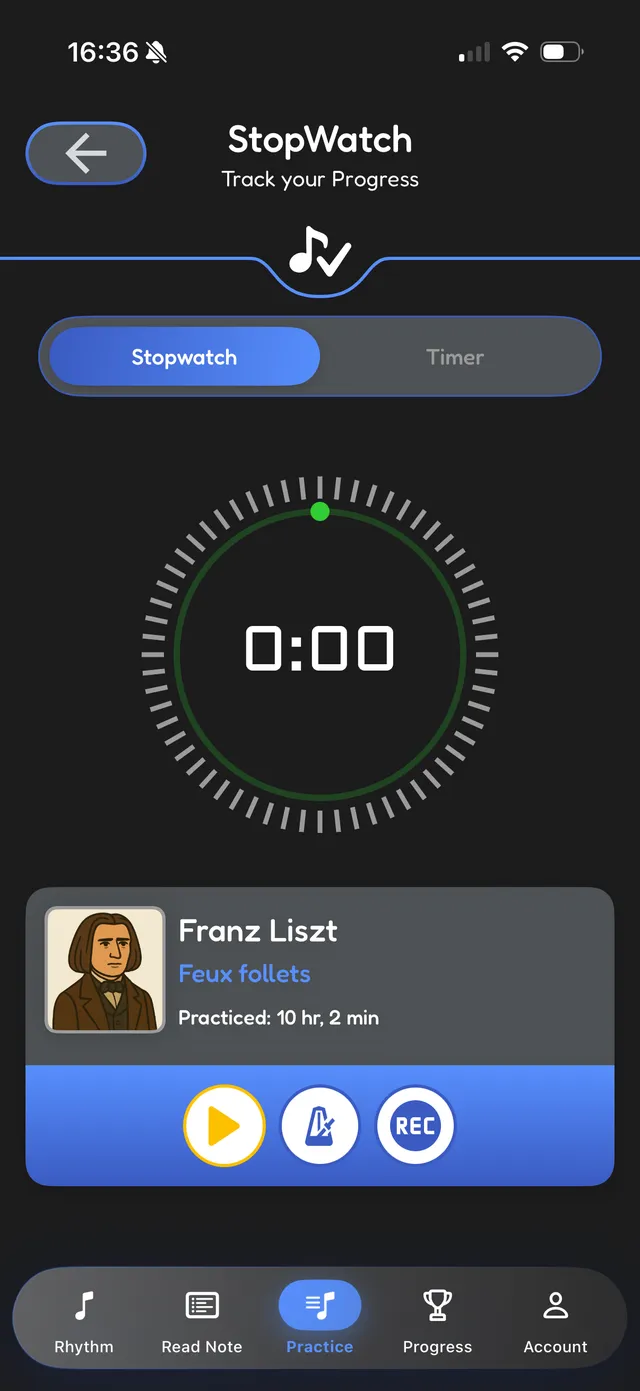
The practice timer in Go Practice Music: give each piece its chunk, switch when it ends — every slice lands in the right history.
Fifty years of evidence, one consistent answer
Researchers call it the contextual interference effect, and it is one of the most consistently replicated findings in the science of motor learning. Since the 1970s, studies of skills from badminton serves to keyboard passages have found the same pattern: people who practise in mixed order look worse during the session than people who practise in blocks — and then outperform them a day or a week later, often by a wide margin. The struggle of switching is not a cost of the method. It is the method.
How to lay out a mixed session
You do not need a spreadsheet — you need a rotation. Choose two or three pieces plus one skill, such as scales, reading or rhythm work. Give each a chunk of five to fifteen minutes: long enough to get inside the material, short enough that you switch before autopilot takes over. Come back to the first piece before you stop, because that second visit — cold, twenty minutes later — is the most valuable retrieval of the day. Then judge the session by how the pieces feel tomorrow, not by how they sounded tonight.
When repetition still wins
None of this means repetition is the enemy. Brand-new material earns a block: the first time you meet a passage, you are still decoding notes and choosing fingerings, and switching away helps nothing. Stay with it until it merely feels awkward instead of impossible. From that point on it belongs to the rotation. A fair rule of thumb: block to acquire, interleave to keep.
Your repertoire list is the rotation
A mixed session needs a menu, and that is what a repertoire list is. In Go Practice Music, every piece you are working on sits in one list with the hours logged against it — so tomorrow’s rotation is already written, and the piece you have quietly been avoiding for three weeks is visible at a glance. Start the practice timer against one piece, switch to the next when its chunk is done, and each slice of the session lands in the right practice history automatically. The app will not make switching feel smoother. It will show you, in hours, why it was worth it.
Practice smarter, starting today
Metronome, practice timer, note reading, rhythm training and more — free to download.
Free to download · iPhone, iPad & Android