Most people who quit an instrument don't quit because they lack talent. They quit because every new piece feels like decoding a cipher — one note at a time, pencil in hand, momentum gone. Fluent note reading is what dissolves that friction. When the dots on the page turn straight into sound in your head and motion in your hands, sheet music stops being a puzzle and becomes a language you simply read. Go Practice's reading trainer is built to get you there, a few minutes at a time.
Reading is really five skills, not one
We talk about "reading music" as if it were a single ability, but fluency is actually a stack: recognizing a note on the staff, recalling its name instantly, knowing where it lives on your instrument, staying aware of the key you're in, and hearing it before you play it. Struggle usually comes from one weak layer, not all five. That's why the trainer separates them into distinct modes — Learning across all seven clefs, Random for honest sight-reading, Piano mode to answer at the keyboard, focused key-signature work, and ear training — so you strengthen the layer that's actually holding you back.
Recognition has to become automatic
A fluent reader doesn't work out that a note is a G — they simply see G. That instant recognition only comes from spaced, repeated exposure, and it's exactly what short daily reps deliver better than occasional long sessions. The Learning mode teaches each clef with a graded method and tracks your completion, so you always meet the next note you're ready for rather than being drowned in all of them at once.
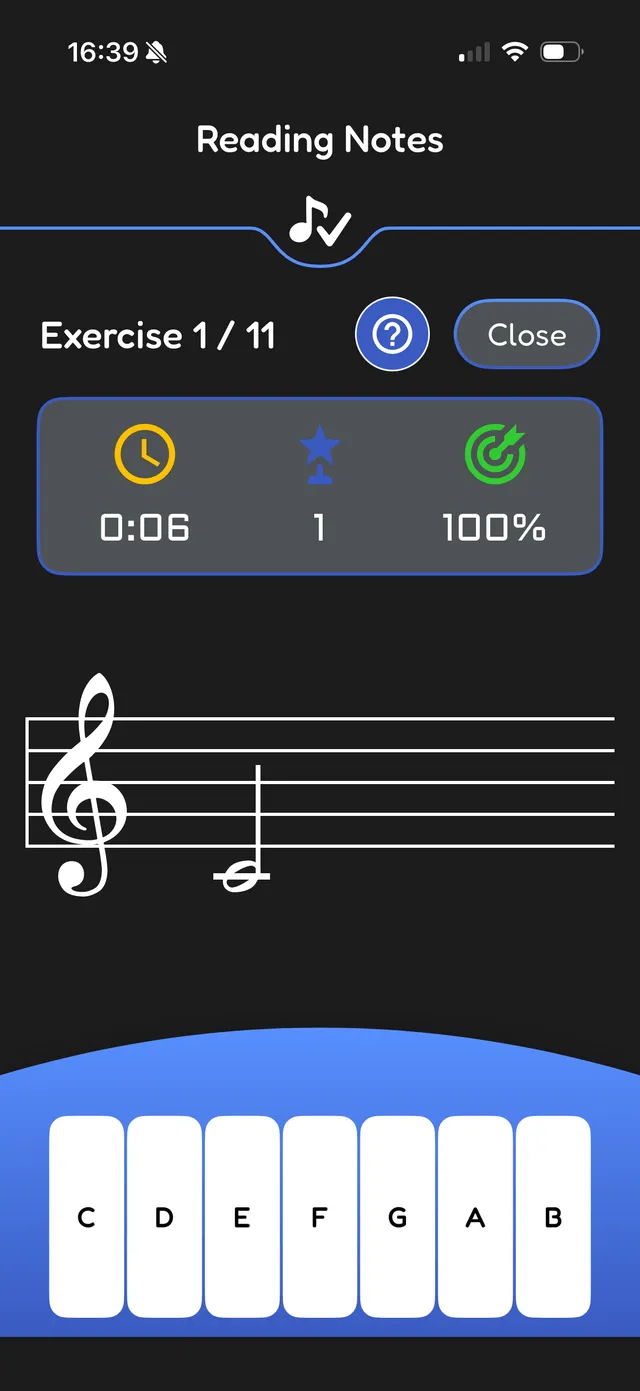
A reading exercise scored at 100% accuracy: read the note on the staff, answer, and watch time, score and accuracy update live.
The page and the instrument are two different skills
Knowing a note's name and finding it under your fingers are separate abilities, and the gap between them is where most sight-reading stalls. That's the point of Piano mode: you read real notation on a real staff and answer at the instrument, with the microphone listening and judging each note you play. Eye, hand and ear train together — which is the only way reading fluency actually transfers to your repertoire instead of staying a flashcard trick.
Keys and ears close the loop
Real music lives in keys, and hesitation over sharps and flats is what makes reading grind to a halt mid-phrase. Working each major key deliberately — organized by accidentals, tracked per key — removes that hesitation. And ear training, naming pitches you hear, builds the inner voice that lets you catch a wrong note before anyone else does. Together they turn reading from a mechanical lookup into genuine musical understanding.
A few minutes a day beats an occasional marathon
Reading is a recognition skill, and recognition is built by frequency, not duration. Five focused minutes before your normal practice — a handful of exercises with live time, score and accuracy on screen — compounds faster than a rare hour-long cram. Because every attempt is measured honestly, you can watch the accuracy climb week over week, which is exactly the kind of visible progress that keeps a hard skill from feeling hopeless.
You don't need to become a professional sight-reader to feel the difference. Even a little fluency means the next piece you're curious about is one you can actually start — no cipher, no pencil, no stalling on the third bar. Open the reading trainer for a few minutes today, and watch how quickly the page starts to sound like music.
Practice smarter, starting today
Metronome, practice timer, note reading, rhythm training and more — free to download.
Free to download · iPhone, iPad & Android