Sit down, open the case, play through the piece a couple of times, run the hard bit until it feels a little less hard, glance at the clock, pack up. It feels like work, and it is — but ask what it was for and the honest answer is usually a shrug. Most practice isn't aimed at anything in particular. It's motion without a target, and motion without a target is how you can log a hundred hours and still feel like you're standing in the same spot.
The players who improve fastest aren't the ones with the most talent or the most free time. They're the ones who sit down already knowing what they're trying to change that day. A goal is simply that knowledge, decided before you start — the quiet difference between practising and merely playing.
Why "get better" is a goal that fails
The trouble with most goals is that they're wishes wearing a goal's clothes. "Get better at the piano," "learn this sonata," "improve my sight-reading" — none of them tell you what to actually do on Tuesday at seven. They're too big to begin and too vague to finish, so they slowly fade into background noise you stop hearing.
A goal only earns its name if it can survive contact with a real session. That means it has to be small enough to attempt today, specific enough that you'll know whether you hit it, and honest enough that you can't quietly fool yourself. "Play the second-page run at 80 BPM three times cleanly" is a goal. "Get better" is a mood.
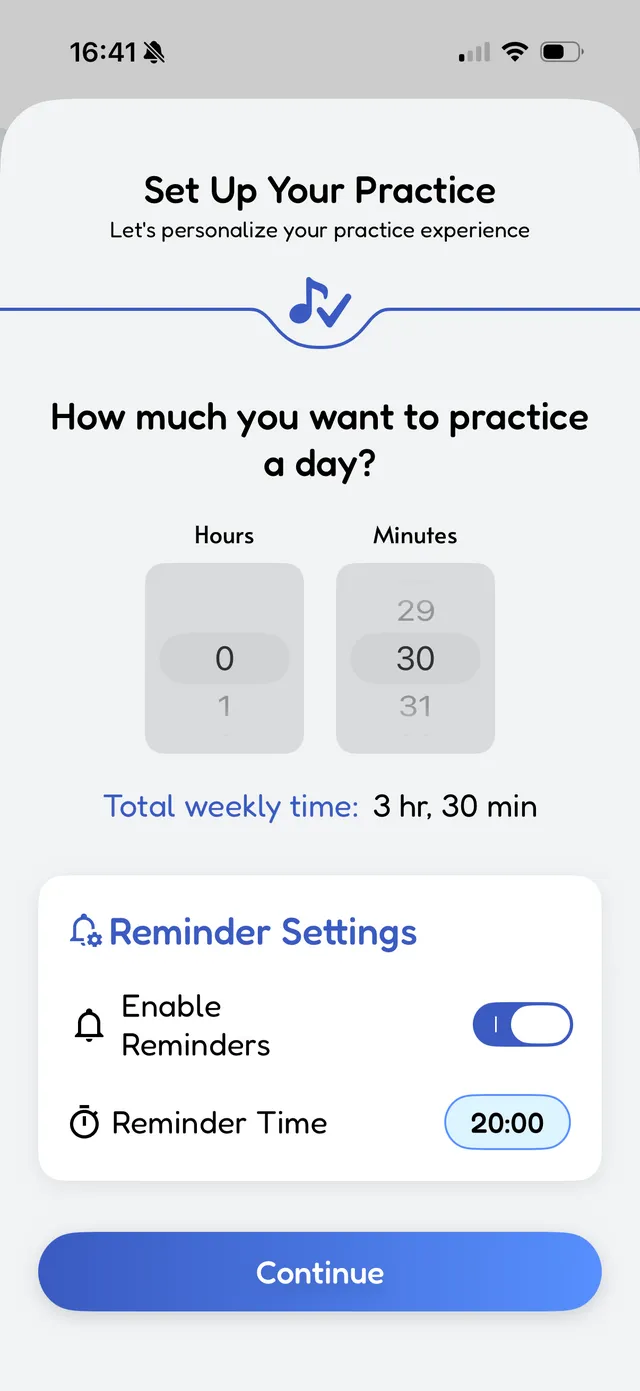
Goal setting in Go Practice Music: name a specific target, attach a reminder so the session happens, and track your progress against it.
What a goal your practice can use actually looks like
Good practice goals share a shape. They name one thing, not five. They carry a number — a tempo, a count of clean repetitions, a stretch of minutes, a date. And they're framed as an action you take rather than an outcome you hope for: "practise the coda hands-separately for ten minutes" sits inside your control in a way that "nail the recital" never will.
Then break the big ambition into a ladder of those small rungs. The sonata you want to learn becomes this week's page, today's four bars, this session's single awkward transition. Each rung is small enough that finishing it is both realistic and satisfying — and satisfaction, repeated often enough, is what quietly keeps you coming back.
The goal you don't have to remember
Setting a goal is easy on Sunday, when motivation is high and the week is still theoretical. Honouring it on Wednesday — tired, with the sofa closer than the instrument — is the hard part. This is where most good intentions quietly die: not from a lack of will, but from simply forgetting, or from letting the decision to practise get argued all over again every single day.
A reminder takes that daily negotiation off the table. When the notification arrives at the time you chose, the decision has already been made; you're just keeping an appointment with yourself. It sounds almost too small to matter, but the research on habit formation is consistent: a reliable cue, tied to a specific time, is one of the strongest predictors of whether a new behaviour sticks.
Goals you can see are goals you keep
A goal kept only in your head competes with everything else in your head, and it usually loses. A goal written down, with your progress visible beside it, becomes something sturdier — a small standing promise you can check, tick off and build on. Watching the tempo climb, the repetitions stack up, the page fill in, turns effort into evidence, and evidence is far more motivating than hope.
That's the thinking behind goal setting in Go Practice Music: you set one concrete target, attach a reminder so the session actually happens, and watch your progress line up against it as the days pass. The goal, the cue and the proof all live in the same place as the pieces you're working on.
Frequently asked questions
How many practice goals should I have at once?
One or two active goals per piece is plenty. More than that and each gets a thinner slice of your attention, so you end up busy rather than focused. Finish a goal, then set the next rung up.
What if I keep missing my goal?
Then the goal is too big — not you. Cut it in half: slower tempo, fewer bars, less time, until reaching it is realistic, and climb from there. A goal you actually reach beats a goal you merely admire.
How specific does a reminder need to be?
Tie it to a real time and, ideally, to something you already do — after breakfast, before dinner. A cue anchored to an existing habit is far harder to ignore than a vague "sometime later."
Practice smarter, starting today
Metronome, practice timer, note reading, rhythm training and more — free to download.
Free to download · iPhone, iPad & Android