Ask ten music teachers for their single most repeated piece of advice and you will hear the same word ten times: slowly. Ask them how to make slow practice honest, and you will hear a second word just as often: metronome. The little clicking device — mocked, resisted, abandoned in drawers — remains the most effective practice tool ever invented. Here is why it works, why most people use it wrong, and a simple routine that will change how your playing feels within weeks.
Rhythm is the skill listeners notice first
Audiences forgive a wrong note far more readily than a wrong beat. A single hesitation breaks the spell of a performance in a way a smudged accidental never does, because pulse is what the listener's body locks onto. Yet rhythm errors are precisely the ones amateur musicians notice least in themselves: while you are busy reading notes and moving fingers, your brain smooths over the tiny hesitations before difficult jumps and the unconscious rushing through easy bars.
The metronome removes that self-deception. It is a neutral, tireless referee that tells you — click by click — where your inner pulse actually stands, not where you believe it stands.
Precision before speed: how professionals build technique
Fast, accurate playing is not built by playing fast. It is built by playing correctly at a tempo where correctness is guaranteed, then raising that tempo so gradually that correctness never breaks. This is the method behind every conservatory practice room door, and the metronome is its engine: it holds the tempo fixed so that the only variable left is you.
Without the click, "slow practice" quietly accelerates the moment a passage feels comfortable — and the errors return with the speed. With the click, each tempo step is earned, measured, and repeatable tomorrow.
Where most people go wrong
The metronome has a bad reputation among some players — "it makes my playing mechanical" — and the criticism is almost always based on misuse. The three classic mistakes: practicing everything with the click until the music never breathes; using it only at full tempo, where it documents failure instead of building success; and treating it as a crutch rather than a mirror — never switching it off to test whether the steadiness has become internal.
Used well, the metronome is temporary scaffolding. The goal was never the click; the goal is the stable inner pulse that remains when the click stops. Expressive timing — rubato, agogic accents, the push and pull that makes music human — only works when it bends against a solid pulse. Musicians with the most freedom in their timing are, without exception, the ones with the strongest metronomic foundation.
A five-step metronome routine that works
- Isolate the passage. Two to eight bars — the spot that actually fails, not the whole piece.
- Find the honest tempo. Slow the click until you can play the passage three times in a row with zero mistakes. That number is your truth. Write it down.
- Subdivide. Set the click to eighth notes for dotted rhythms and syncopation. Feeling the subdivision is what keeps long notes from shrinking.
- Climb in small steps. Raise the tempo 4–8 BPM after each clean set of repetitions. If it breaks, drop back two steps — no negotiation.
- Turn it off and verify. Play the passage without the click and listen: does the steadiness survive? That, not the highest BPM you reached, is the result.
The right tool, one tap away
Any metronome is better than none, but friction kills routines — if starting the click takes longer than avoiding it, it stays in the drawer. That's why Go Practice Music builds the metronome directly into the practice screen, one tap from your pieces and your timer.
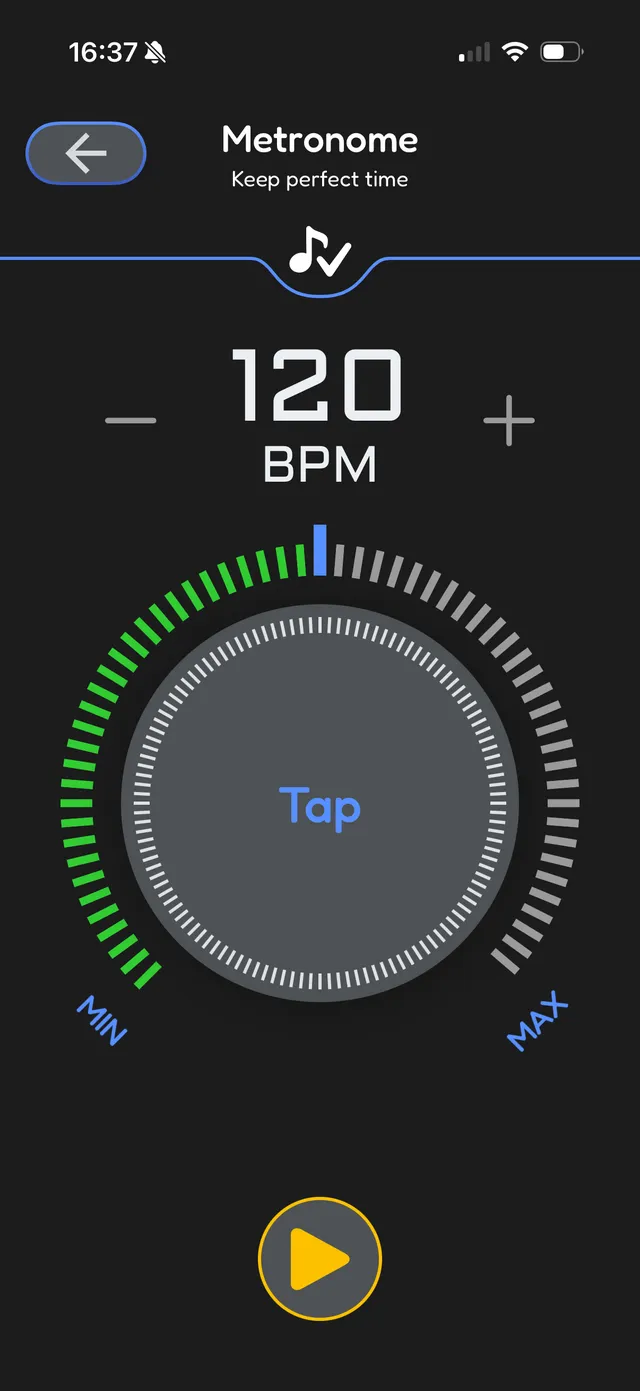
The Go Practice Music metronome: a full-width tap-tempo dial, precise BPM control from largo to presto.
Tap the large dial to find any tempo by feel, fine-tune with plus and minus, and read the range from min to max at a glance — exactly what the five-step routine above needs. And because it lives inside the same app that times your sessions and trains your rhythm through eighteen graded levels, the minutes you spend with the click are logged to the piece you're working on, automatically. You can explore the full feature on the metronome section of our homepage.
Frequently asked questions
How long should I practice with a metronome each day?
You don't need it for the whole session. Ten to fifteen focused minutes on technically demanding passages beats an hour of mindless clicking. Use it where precision matters, then turn it off and check whether the steadiness survives.
What tempo should I start at?
Slow enough that you can play the passage with zero mistakes — often 50–60% of the target tempo. If you can't play it perfectly slowly, you can't play it correctly fast.
Does relying on a metronome make playing mechanical?
Used correctly, the opposite: it builds the stable inner pulse that expressive timing is measured against. The freest rubato stands on the firmest foundation.
Practice smarter, starting today
Metronome, practice timer, note reading, rhythm training and more — free to download.
Free to download · iPhone, iPad & Android