Most players who keep a practice log stop at the first question: did I practise today? It is a good question, and answering it honestly for a few weeks will already change your playing. But there is a second question hiding behind it, and it is the one that actually decides how fast you improve: what did I practise?
Your memory is not a record
Ask a player what they worked on last week and you will get an answer shaped by how the week felt, not by what happened. The frustrating twenty minutes on a hard passage feels like an hour. The forty minutes spent playing a piece you already know feels like five. Memory keeps the emotional highlights and throws away the arithmetic. A chart does the opposite: it is boring, and it is right.
Everyone drifts toward what they are good at
This is the single most common pattern the numbers expose, and almost nobody sees it without them. Practice is more pleasant when it sounds good, so week by week your sessions quietly tilt toward the pieces you can already play and away from the skills that feel clumsy — usually reading, usually rhythm, usually the ear. Nobody decides to do this. It happens the way water finds a slope. Six weeks later you are a better performer of four pieces and no better a musician, and you cannot understand why the new score still looks like a wall.
A chart split by discipline ends that argument in about four seconds. If reading is a sliver and repertoire is most of the bar, you now know something true that you could not have felt.
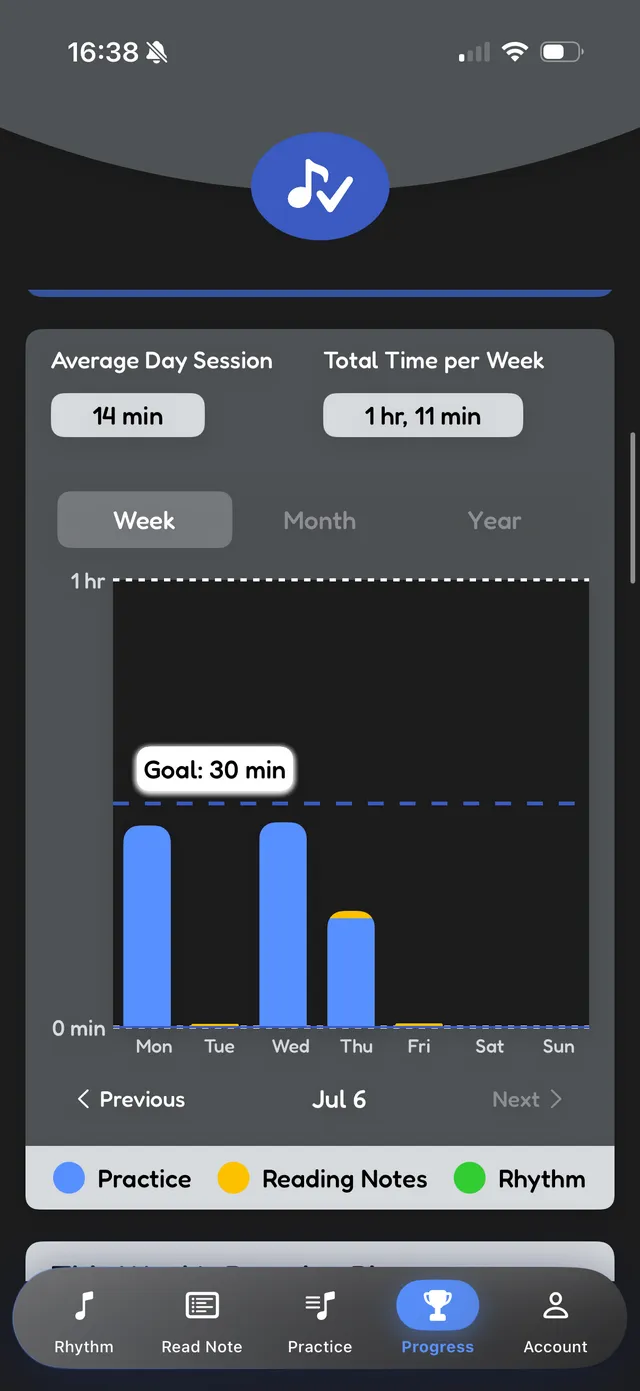
A week at a glance: total time, and how it was split between your instrument, reading, rhythm and ear training.
What a week actually looks like
Look at three things and nothing else. First, the shape: are you playing a little most days, or everything on Sunday? Both add up to the same total and they do not produce the same skill. Second, the split: how much of the week went to each discipline, and is that the split you would have chosen on purpose? Third, the outlier: the one day that was much bigger or much smaller than the rest, and what was different about it. That last one is where you find your real conditions for practising — a free morning, a piece you loved, a room you did not have to share.
The year view is for perspective, not for guilt
Zoom out and something reassuring appears: everyone has bad months. Exams, illness, moving house, a long stretch of work. On a yearly chart those dips are small and the trend line still climbs, which is exactly the fact you cannot access on the third bad day in a row. The year view is also where slow skills finally become visible — ear training that felt pointless in week two shows up as a real, accumulated column by month five.
Five minutes, once a week
Pick a fixed moment — Sunday evening works for most people because the next week has not started yet. Open the weekly chart, read the three things above, and then change exactly one thing. One. Move ten minutes from repertoire to reading. Add a rhythm session on the two days you already practise reliably. Protect the day that keeps collapsing. A review that produces five changes produces none of them; a review that produces one change tends to survive the week.
The point is not the numbers
Nobody gets better because a bar got taller. The chart is useful for one reason only: it replaces a story you tell yourself with a thing that happened, and it does it in less time than tuning takes. Practise well during the week. On Sunday, spend five minutes finding out what you actually did — and let that, rather than your mood, choose Monday.
Practice smarter, starting today
Metronome, practice timer, note reading, rhythm training and more — free to download.
Free to download · iPhone, iPad & Android