Every musician has felt it: the notes are right, the fingers land where they should, and the passage still sounds off. Nine times out of ten the culprit isn't pitch — it's rhythm. Rhythm is the part of music a listener feels in their body before they consciously hear anything, and it's the one most practice routines quietly neglect. We drill scales and chords for years while assuming the beat will take care of itself. It won't. Rhythm is a skill you can train on purpose, and training it deliberately is one of the fastest ways to sound like a musician instead of someone reading music.
The beat is the one thing you can't fake
A wrong note is a moment; a wrong beat is a collapse. When your timing wavers, the listener's foot stops tapping and the spell breaks — even when every pitch was perfect. Pulse is how humans lock onto music: we synchronise with the beat without thinking and feel any deviation as tension or mistake. You can play a handful of notes and still move a room if your rhythm is solid, and you can play every note in the score and lose the audience if it isn't. Rhythm isn't the backdrop to the music. For the listener, it often is the music.
Reading rhythm and feeling rhythm are different skills
Here is the trap self-taught players fall into: they can explain that a dotted quarter lasts a beat and a half, but they can't feel it land. Knowing the arithmetic of a rhythm and being able to perform it under pressure are two separate abilities, and only one of them shows up when you play. The gap closes through a particular kind of repetition — clapping, tapping and counting patterns until they become physical rather than mathematical. That is what rhythm training really is: not memorising what the symbols mean, but wiring the pattern into your body so it comes out without translation.
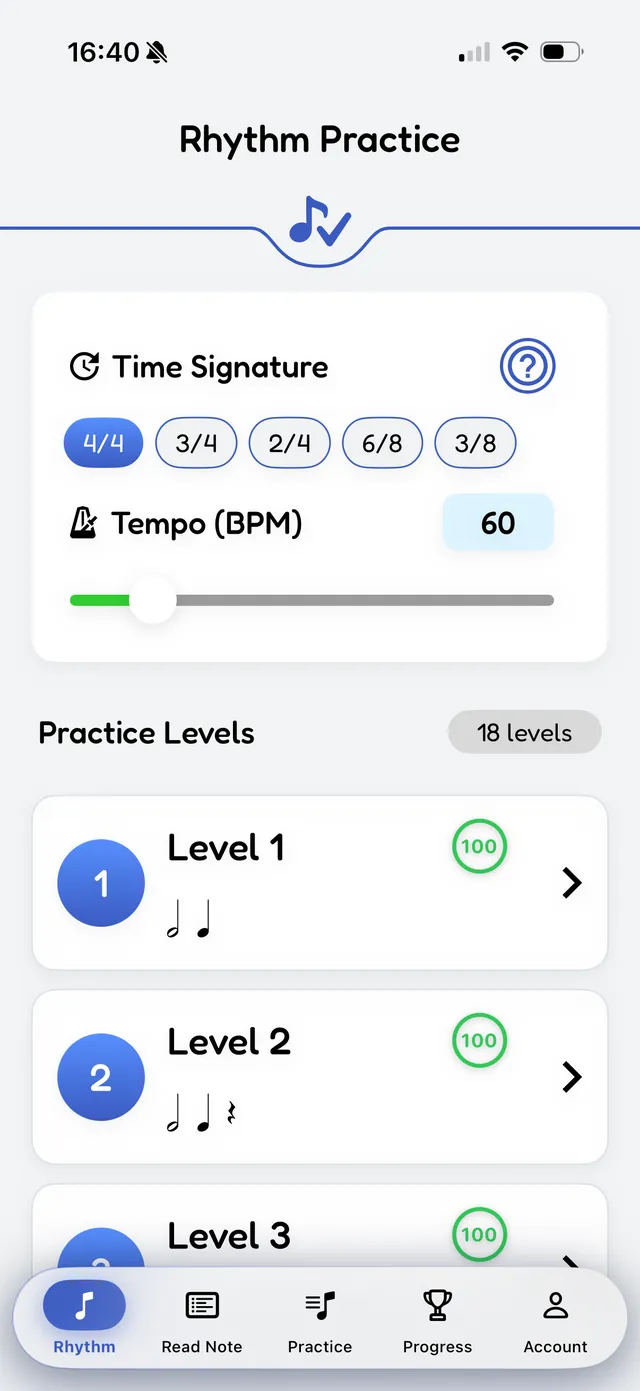
The Go Practice Music rhythm trainer: eighteen graded levels from steady quarter notes to syncopation, with tap-along feedback on every beat.
Why graded levels beat random drilling
Rhythm gets harder in a predictable order. Quarter notes before eighths, eighths before sixteenths, simple time before compound, and only then syncopation, ties across the beat and the genuinely awkward business of rests. Working through that order — securing one layer before adding the next — beats hurling yourself at a hard passage and hoping. A graded sequence keeps you at the edge of what you can do: never bored, never drowning. Each level you clear becomes the solid ground the next one stands on, and the curve stays gentle enough that you actually keep going.
You don't even need your instrument
One quiet advantage of rhythm practice is that it travels. You don't have to be at the piano or holding your guitar — you can tap a pattern on a table, on the bus, in a waiting room. Because rhythm lives in the body rather than the fingers, a few minutes of tapping trains the exact skill you'll use when you sit down to play for real. That makes it perfect for the small gaps in a day that would otherwise go to waste, and it's why rhythm is one of the easiest musical skills to turn into a genuine daily habit.
Five minutes a day, built into your practice
Go Practice Music includes a rhythm trainer built for exactly this: eighteen graded levels that carry you from steady quarter notes all the way to real syncopation, across five time signatures, with a tap-along interface that tells you instantly whether you caught the beat. Because it lives inside the same app that times your sessions and holds a steady click, the minutes you spend drilling rhythm are logged next to the rest of your practice — so a skill that's easy to skip becomes one you can watch improve. Five focused minutes a day, and within a few weeks the beat stops being something you count and starts being something you feel.
Frequently asked questions
How is rhythm training different from using a metronome?
A metronome gives you a steady reference to play along with; rhythm training builds the internal patterns you play in the first place. They work best together — the trainer teaches your body the figure, the metronome keeps it honest.
How long until I notice a difference?
Most players feel steadier within two or three weeks of short daily sessions. Rhythm responds quickly to consistency because it is a physical skill, not a knowledge one.
I'm a complete beginner — is it too early?
It's the perfect time. Building a solid sense of pulse before bad timing habits set in is far easier than correcting them later. Start at level one and climb.
Practice smarter, starting today
Metronome, practice timer, note reading, rhythm training and more — free to download.
Free to download · iPhone, iPad & Android