You know the pattern. Monday to Friday the instrument sits there, quietly reproachful. Then Sunday afternoon arrives, you clear three hours, and you play until your hands ache — and it feels like real practice, because it was hard and it cost you an afternoon. The trouble is that your hands and your memory disagree about what counted. Almost everything we know about how skills are built points the same way: five short sessions across the week beat one long one at the end of it.
The long session feels like the serious one
Effort is the only measure of practice most of us can feel directly, and three hours is unmistakably more effort than fifteen minutes. So we treat the long session as the real work and the short one as barely worth counting — not enough time to get warm, not enough time to get anywhere.
That instinct quietly costs you twice. It costs you the four days you skipped because you could not face the full ritual, and it costs you the part of learning that only happens in the gaps between sessions.
Most of the learning happens after you stop
Practice does not install a skill; it starts a process. The consolidation — the part where a passage stops being something you fight and becomes something your hands simply know — happens afterwards, and largely while you sleep. Work on a difficult bar on Monday and the version you meet on Tuesday is often better than the one you left behind, without a single extra repetition.
Which means every additional day you touch the instrument is another consolidation cycle. Five sessions gives you five of them. One long Sunday gives you one, however many hours you pour into it. That is the real argument for spacing: the calendar is doing work the clock cannot.
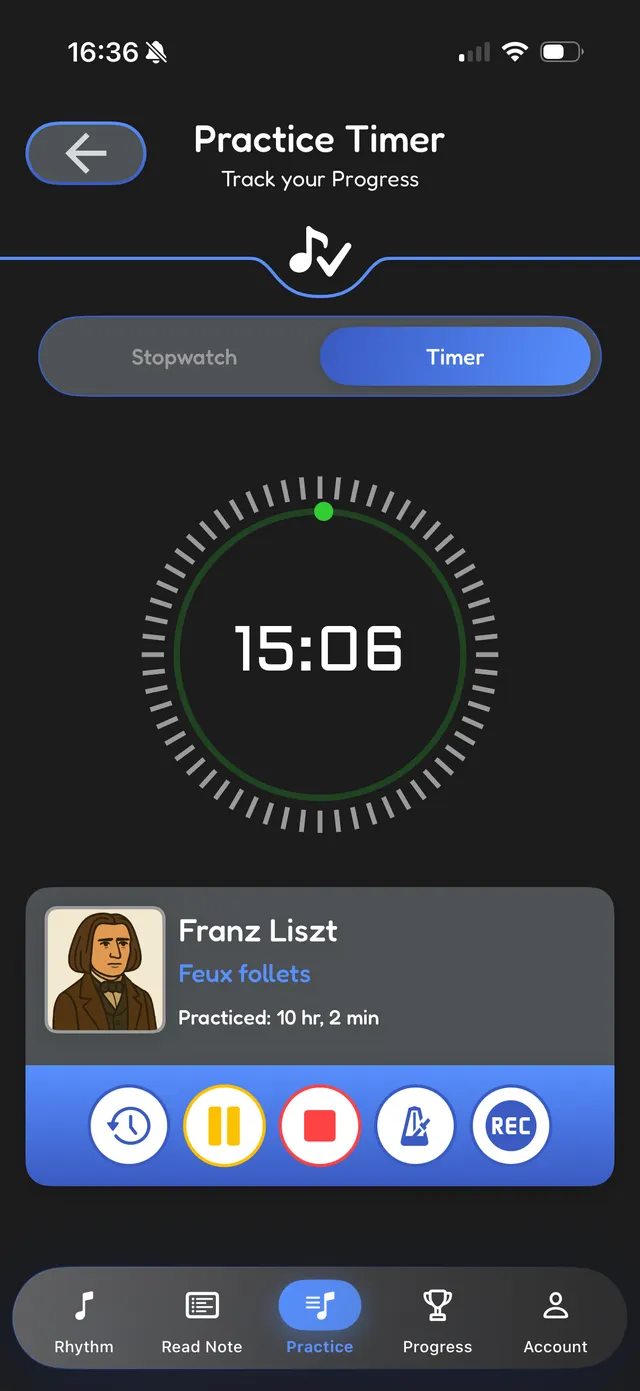
A fifteen-minute session you actually start beats a three-hour one you keep postponing — and the timer logs it against the piece either way.
Long sessions have a quiet ceiling
Attention is not spread evenly across three hours. The first half hour is focused. Somewhere after the first hour the repetitions get looser, the ear stops catching small errors, and you begin practising the mistakes along with the notes. Fatigue makes technique sloppy, and sloppy repetitions are not neutral — they are teaching too, just not what you wanted.
A short session is almost entirely first-half-hour. That is its unfair advantage: the whole thing happens while you are still sharp.
Fifteen minutes is enough to move something
The usual objection is that you cannot get anything done in fifteen minutes. You cannot get everything done, which is a different problem, and the fix is to stop trying. Fifteen minutes comfortably fits a proper warm-up and one problem bar. Or a scale and three slow passes at the passage you keep fumbling. Or a page of reading. Or the transition you have been avoiding for three weeks.
Choose the target before you sit down and the session stops being a shrunken version of a big session. It becomes its own thing: narrow, finishable, and far easier to start again tomorrow.
How to lay out a practice week
Attach the session to something already fixed in your day — after your morning coffee, before dinner, the moment you get home. A habit needs a cue more than it needs willpower. Then set the floor embarrassingly low: fifteen minutes, and you are allowed to stop there. Most days you will play longer, but the promise you made was small enough to keep on the bad days, and the bad days are what decide whether a habit survives.
Start the timer when you sit down — not for discipline, but for evidence. Fifteen minutes feels like nothing until you see six of them stacked against one piece and realise the week held an hour and a half you would have sworn you never practised. Go Practice Music runs the timer against the specific piece you are working on, so those minutes land in your practice history instead of evaporating.
And keep a never-miss-twice rule. One skipped day is noise. Two is the beginning of a different pattern.
When the long session earns its place
None of this makes long sessions useless. Some work genuinely needs continuous time: playing a programme end to end, recording a take and listening back properly, sorting out fingering for a whole movement, rehearsing with other people. Endurance is its own skill, and you cannot build it fifteen minutes at a time.
So keep the Sunday afternoon if you have it. Just stop asking it to carry the week. The three hours are where you find out what your playing sounds like. The fifteen minutes, five days running, are where it actually changed.
Practice smarter, starting today
Metronome, practice timer, note reading, rhythm training and more — free to download.
Free to download · iPhone, iPad & Android