Every musician has heard the advice, and almost nobody follows it: if you want to learn a passage, play it slowly. It feels wrong. Slow practice looks like standing still while everyone else races ahead — the piece sounds nothing like the recording, and the temptation to speed up wins within minutes.
Yet ask any teacher, any conservatoire student, any player in an orchestra pit, and you will hear the same thing: the musicians who progress fastest are the ones willing to play slowest. This article is about why that is true, and how to make slow practice something you actually do — not just something you know you should do.
Speed hides everything you need to fix
Play a difficult bar at full tempo and the mistakes blur together. You know something went wrong, but not what: was the shift out of tune, did the third finger land late, did one voice of the chord stick out? At speed, it all rushes past before your ear can catch it.
Slow the passage down and every detail becomes audible. The early note stands exposed. The tension in your wrist has time to register. Slow practice is not a punishment for playing badly — it is a magnifying glass. You cannot fix what you cannot hear, and at full tempo you hear almost nothing.
What slow practice actually trains
Your hands record everything you do, right or wrong. That is how motor learning works: every repetition strengthens the version of the movement you just made. Which means that rushing through a passage with errors is also practice — practice of the errors.
Playing slowly enough to be correct changes the arithmetic entirely. Now each repetition writes the version you actually want to keep: the clean shift, the relaxed hand, the even rhythm. Speed, when it comes later, is mostly a change of playback rate applied to movements that were learned properly in the first place.
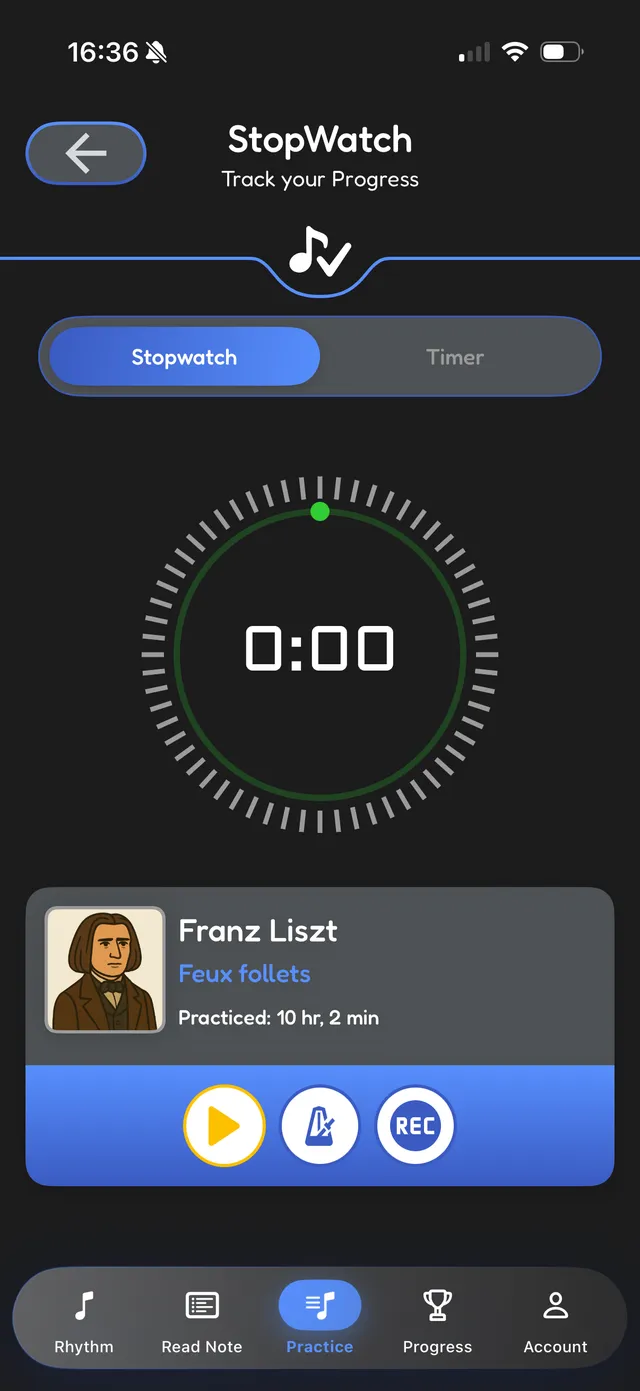
The practice timer in Go Practice Music logs every focused minute against the piece you are working on — slow sessions count as real, visible work.
How slow is slow enough?
Here is an honest test: choose a tempo at which you could play the passage three times in a row without a single mistake. If you cannot, go slower. For most of us that tempo is far below what pride prefers — half speed or less on a new passage is completely normal.
The good news is that tempo comes back faster than you fear. Movements learned correctly speed up quickly, because there is nothing to undo. Movements learned sloppily have to be unlearned first, and unlearning is the slowest process in all of practice.
A simple slow-practice routine
Take a short passage — two to four bars is plenty. Play it at a tempo where everything feels easy, almost boring. Repeat it until you get three clean playings in a row, then nudge the tempo up a small step. If the same mistake appears twice, drop back down and stay there a little longer.
Fifteen minutes of this does more for a difficult passage than an hour of playing the piece through and hoping. Run-throughs have their place, but they are a performance skill; slow work is where the learning happens.
Time it, or it will not happen
Slow practice is the easiest kind to abandon, because in the moment it never feels like progress. Nothing sounds impressive. Nobody would applaud. The only evidence that it worked arrives days later, when the passage suddenly plays itself.
This is exactly where a timer earns its keep. Start the practice timer in Go Practice Music on the piece you are working on, and every slow, careful minute is counted and logged against that piece. When the session sounds unglamorous, the timer quietly disagrees: forty logged minutes of focused work is forty minutes, whatever it sounded like. Over weeks, those logged hours become the proof — per piece — that the unspectacular work is being done.
Slow today, effortless next month
The paradox of slow practice resolves once you see it as a bet placed on your future self. The player who spends this week at half tempo is the one who plays the passage effortlessly next month, while the player who kept pushing the tempo is still stumbling in the same bars.
So protect ten slow minutes a day. Choose one passage, set the tempo embarrassingly low, start the timer, and let the app keep score. Slow is not the opposite of fast — it is the way there.
Practice smarter, starting today
Metronome, practice timer, note reading, rhythm training and more — free to download.
Free to download · iPhone, iPad & Android