Most missed sessions were never really a decision
Ask why yesterday's practice didn't happen and you'll usually hear "no time" or "too tired". Sometimes that's true. But replay the day honestly and a different story often emerges: practising never came up. There was no moment where you weighed it and chose not to. The day filled itself, and by evening the question had quietly answered itself.
That distinction matters, because it changes what the problem actually is. If you had decided against practising, the fix would be motivation. You didn't decide anything — so the fix is much smaller. You need the thought to arrive while there's still time to act on it.
Willpower is the expensive fix
The usual advice is to want it more. Care about your goals, remember why you started, push through. That works on the days you were going to practise anyway, and fails on exactly the days you needed it — the tired ones, the busy ones, the ones where the instrument feels like a chore rather than a pleasure.
People who practise consistently rarely describe a daily act of will. They describe a trigger: after coffee, before dinner, once the kids are down. The habit is attached to something that already happens, so it never has to be summoned out of nothing.
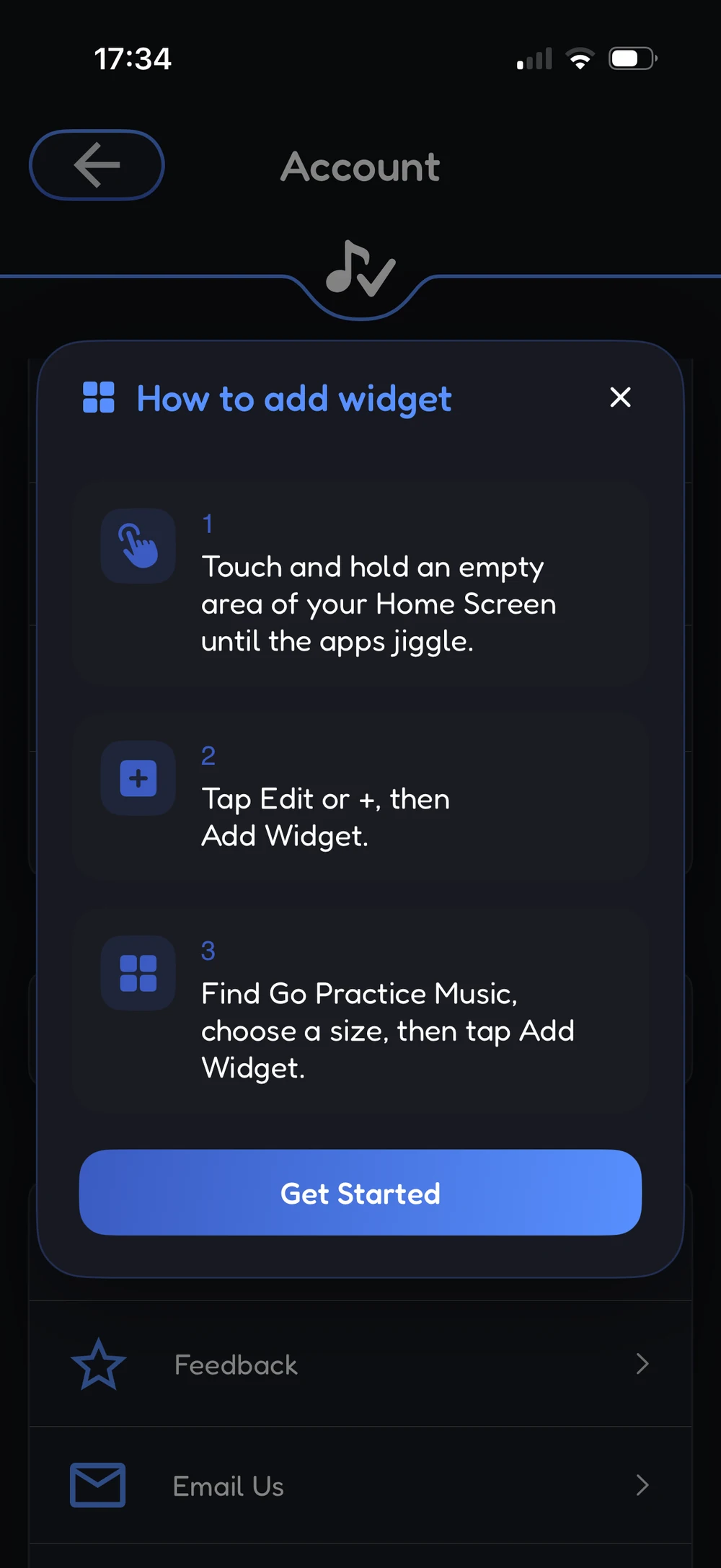
Your streak and today’s minutes, sitting on the home screen — a reminder you don’t have to remember to look at.
A cue you don't have to remember
The catch with triggers is that you have to build them, and in the meantime something has to carry the reminder. Notifications are one answer, but a poor one: they arrive on someone else's schedule, usually mid-task, and after a week your thumb dismisses them before your brain has read them.
A home-screen widget works differently. It doesn't interrupt — it waits. You unlock your phone dozens of times a day for reasons that have nothing to do with music, and each time your streak and today's minutes are simply there, in your field of view. No decision to open an app. No notification to dismiss. Just a quiet, repeated fact.
Why a number lands harder than a reminder
"Time to practise" is advice, and advice is easy to argue with. "12 days · 0 minutes today" is not advice — it's a state of affairs, and a slightly uncomfortable one. Most people find a small, accurate number far more persuasive than any amount of encouragement, because there is nothing in it to disagree with.
It cuts the other way too, which is the point. On a day when the widget already reads twenty minutes, you get to stop feeling vaguely guilty about it. The number closes the day as much as it opens it.
Protect the streak, not the hour
A visible streak carries an obvious risk: it can turn into pressure, and pressure is how people quit. The way around that is to make your minimum genuinely small. Five minutes counts. Scales while the kettle boils counts. A streak that only survives on good days isn't a streak — it's a scoreboard you'll eventually resent.
Kept small, it does something useful instead: it protects the habit on the bad days, so the good days still have somewhere to land.
Ten seconds is the whole battle
Almost nobody starts a practice session and then abandons it two minutes later. Once you're sitting down with the instrument in your hands, the session happens. Everything that goes wrong, goes wrong before that — in the ten seconds where practising could have crossed your mind and didn't.
That's a very small problem to solve, and it doesn't require wanting it more. It requires the thought showing up on time. Put it where you're already looking.
Practice smarter, starting today
Metronome, practice timer, note reading, rhythm training and more — free to download.
Free to download · iPhone, iPad & Android