Almost every player knows they should warm up. Almost nobody does. The case opens, the piece that matters goes on the stand, and within thirty seconds you are attacking the hardest bar in it — cold hands, unfocused ears, and a body that has not yet remembered what it is supposed to do.
Then the session goes badly, and the conclusion you draw is that the passage is difficult. Often it isn't. You just weren't ready to play it yet.
A warm-up is for your attention, not just your hands
The physical side is real. Cold fingers move less accurately, and a cold shoulder braces without asking permission. But the larger effect of a warm-up is mental. Most of us arrive at the instrument still carrying the rest of the day — a conversation, a deadline, a phone that just buzzed. Playing something simple and familiar gives your attention somewhere to land before you ask it to do difficult work.
That is why a warm-up should be easy enough to be boring. Long tones, slow scales, an open-string bow, a five-finger pattern: material that requires no problem-solving, so your ears get to do the listening instead of your brain doing the deciphering.
What skipping it quietly costs you
The first cost is tension. When the hands aren't ready, you compensate with force — and force is a habit. Practise a passage tightly for twenty minutes and you have taught yourself to play it tightly.
The second is accuracy. The mistakes you make in the first cold minutes are not neutral. They are repetitions like any other, and your body files them away with the same care it gives the good ones.
The third is the one nobody notices until it matters: injury. Tendon problems in musicians are rarely caused by one dramatic session. They are built slowly, out of hundreds of starts made with cold, tight hands.
Ten unhurried minutes is enough
A warm-up does not need to be a ritual with twelve parts. Ten minutes, roughly in this shape, covers almost everything.
Two or three minutes of sound alone: long tones, sustained notes, slow bows, held chords. Listen to the beginning and the end of each note, and nothing else. Then four or five minutes of simple movement — scales or arpeggios at a tempo that feels slightly too slow, played evenly. Then two or three minutes of something you already play well, a piece you finished months ago. It reminds your hands what ease feels like before you ask them for difficulty.
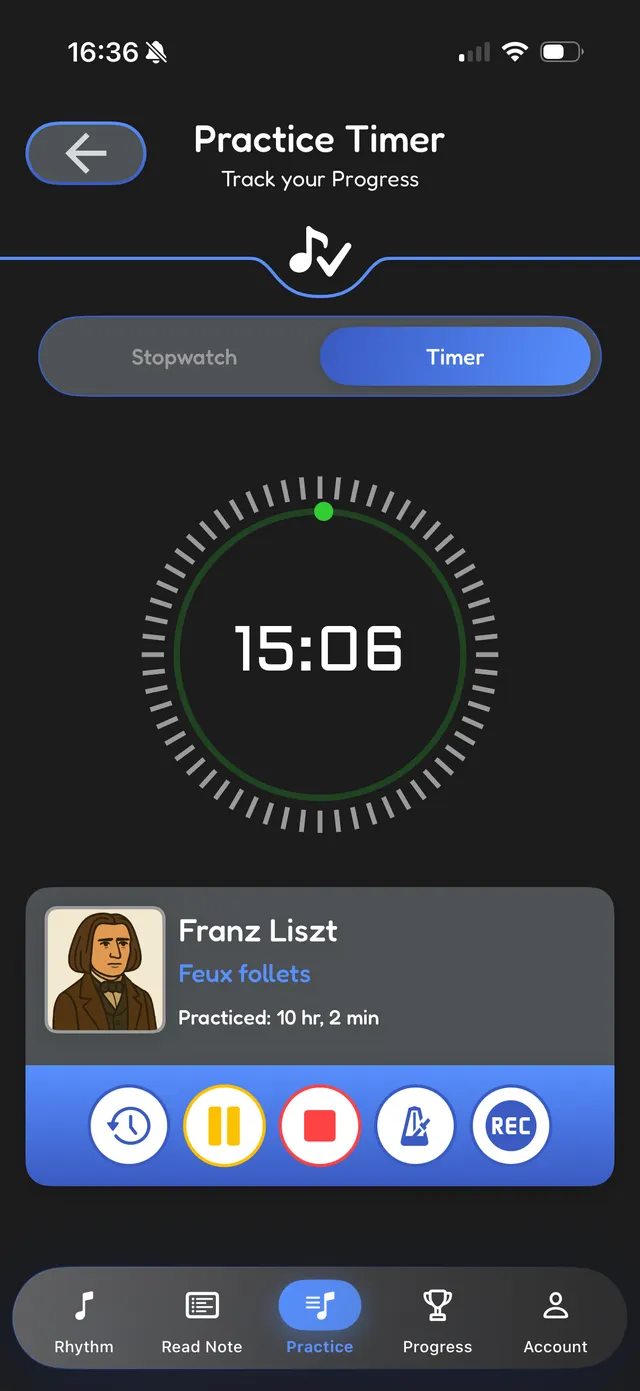
Start the stopwatch when you pick the instrument up — the warm-up counts toward your day like everything else.
Keep it separate from the piece you care about
The most common mistake is using the hard piece as the warm-up. It feels efficient. It isn't. You end up spending your freshest, most focused minutes playing badly, and your least focused minutes trying to repair what you broke.
Give the warm-up its own space at the start of the session, and let the piece begin when you are genuinely able to play it. You will often find that the passage you have been fighting for a week is simply easier at minute twelve than it was at minute one.
Time it instead of guessing
Warm-ups drift. Without a clock they either shrink to ninety seconds because you are impatient, or swell to twenty-five minutes because scales are comfortable and the new piece is not. Both are ways of avoiding the session.
Starting a timer fixes this almost by itself. In Go Practice Music you can start the stopwatch the moment you pick the instrument up and let it run against the piece you are working on, so the warm-up isn't unrecorded time — it is part of your practice, counted like everything else. Seeing it in your log is also how you find out whether you actually do it, or only believe you do.
The same opening, every day
The point of a warm-up is not the exercises. It is the transition: from the rest of your life into the twenty or sixty minutes in which you are a musician. A routine you repeat without thinking becomes a signal, and after a few weeks that signal starts doing half the work. You sit down, play the first long tone, and your attention arrives on its own.
Keep it short, keep it dull, keep it the same. Then start the piece.
Practice smarter, starting today
Metronome, practice timer, note reading, rhythm training and more — free to download.
Free to download · iPhone, iPad & Android