Two musicians sit down to practice the same piece for the same thirty minutes a day. A year later, one of them plays it; the other plays around it. The difference is rarely talent, and it is almost never the number of hours. It is feedback: one of them knows what actually happened in those hours, and the other only remembers what it felt like. Tracking your practice — honestly, lightly, every day — is the cheapest upgrade available to any musician at any level. Here is why it works, what the research says, and how to do it without turning music into bookkeeping.
Memory is a flattering historian
Ask yourself how much you practiced last week, and your memory will hand you a warm estimate assembled from your two best days. This is not a character flaw; it is how memory works. We recall peaks and endings and quietly discard the skipped Tuesday, the session that dissolved into scrolling, the "twenty minutes" that was really eight. Studies of self-reported behavior — from exercise to study time — show the same pattern everywhere: people overestimate their own effort, often by half.
A practice log ends the negotiation. Timed sessions, written to the piece you worked on, are a neutral record of what happened — not a referendum on how motivated you felt. And exactly like the metronome does for rhythm, the log replaces a comfortable illusion with a workable truth.
The streak: consistency made visible
Skill on an instrument compounds through frequency, not heroics. Six days of twenty minutes beat one day of two hours, because myelination — the physical process by which your nervous system consolidates a movement — is triggered by repeated, spaced signals, and because a daily encounter keeps the music warm in your ear. The problem is that consistency is invisible: nothing celebrates the fourteenth ordinary Tuesday in a row.
A streak counter fixes that. The moment your unbroken chain of practice days has a number on it, that number becomes something you own and defend. Comedians call it "don't break the chain"; behavioral scientists call it a commitment device; musicians who use one simply call it the reason they practiced on the day they least wanted to. And those reluctant ten-minute sessions — the ones the streak rescues — are precisely the ones that separate players who improve from players who restart every September.
Numbers turn guilt into decisions
Untracked practice produces a vague, useless feeling of "I should be doing more." Tracked practice produces specific, answerable questions. Three pieces in your repertoire, but the hours show you've given one of them 80% of your time? Rebalance tomorrow. The weekly chart shows you always miss Thursdays? Move Thursday practice to the morning. Your total on the étude just crossed ten hours and it still isn't settling? The problem isn't quantity anymore — change the method, slow the tempo, isolate the passage.
This is the quiet superpower of a practice history: it converts anxiety into information. You stop arguing with yourself about whether you're doing enough, because the answer is on the screen — and every decision you make from it is a decision based on your actual practice life, not your imagined one.
What to track (it's less than you think)
- Time per piece. Not just total time — time attached to the music it served. This is what reveals neglect and balance.
- Your daily streak. The single most motivating number in practice. Protect it with a minimum viable session on busy days.
- A goal for today. A target in minutes turns "practice sometime" into a finish line you can cross before dinner.
- One line about tomorrow. "Bar 24, left hand, slower." Your future self starts the next session already knowing where to aim.
That's the whole system. If logging takes more than a few seconds, it will compete with the music — and the music should always win.
Tracking without the friction
Paper journals work until they stay in the other bag. Spreadsheets work until the third week. The reason Go Practice Music was built around automatic tracking is that the best log is the one you never have to remember to keep: start the timer on a piece and the minutes land in that piece's history by themselves — while the streak, the daily goal and the totals update at the top of your practice screen.
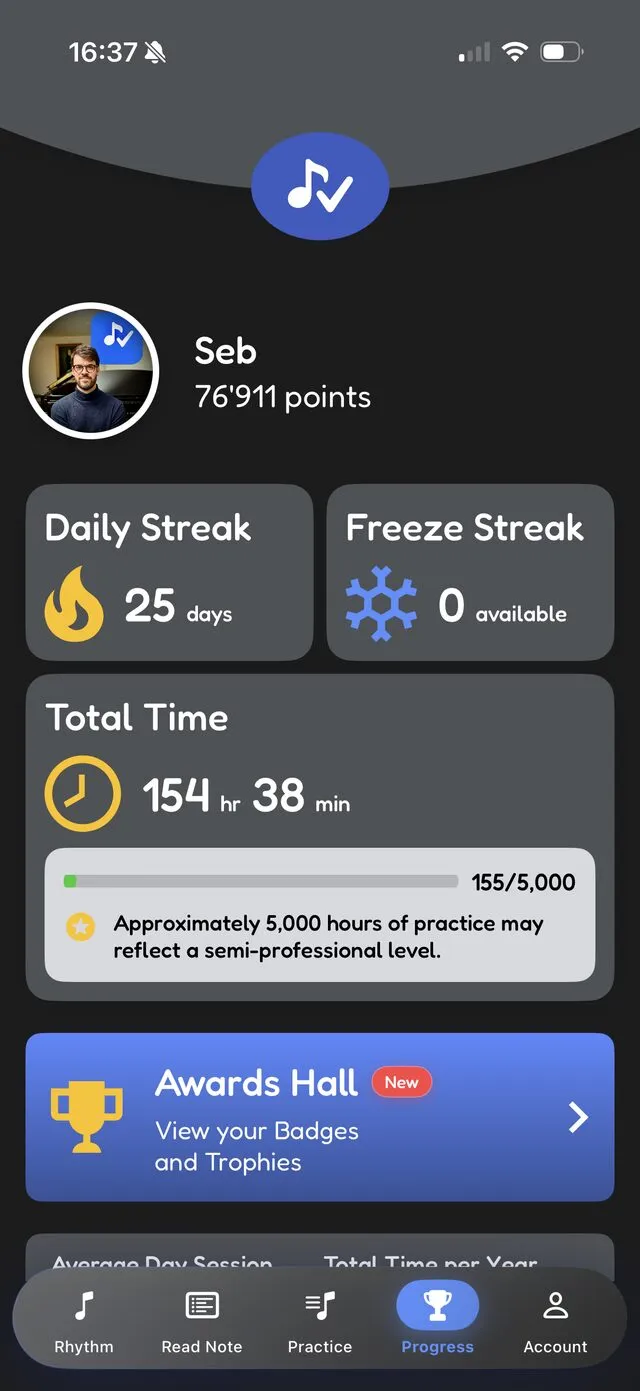
The Go Practice Music progress dashboard: streak, total time, awards and your practice history in one place.
The progress dashboard gathers it all: your streak with its freeze protection, hours per piece, weekly and yearly charts with your goal line drawn in, and the awards you collect along the way. There is even a weekly league, so the consistency you build quietly at home can compete out loud. Prefer to see it in motion? The short video tours on our homepage walk through the whole flow in under two minutes.
Frequently asked questions
How much detail should I track?
Less than you think: minutes per piece, your streak, and one sentence about tomorrow. If the log becomes homework, you'll abandon it — seconds, not minutes.
Does a streak really help motivation?
Yes. A visible unbroken chain turns consistency itself into a reward, and the ten-minute session that saves a streak is worth more over a year than an occasional heroic marathon.
Should beginners bother tracking?
Beginners benefit most. Early progress is real but hard to hear day to day — which is exactly when most people quit. The log makes invisible progress visible before the ear can confirm it.
See your progress add up
Automatic practice tracking, streaks, goals, charts and weekly leagues — free to download.
Free to download · iPhone, iPad & Android