Every music teacher knows the moment: a student plays a passage, visibly satisfied, and the teacher plays back a recording of it. The silence that follows is where real progress begins. Nothing in a musician's toolkit closes the gap between how it felt and how it sounded faster than a recording — and yet most of us avoid it for years, because the playback tells the truth and the truth takes a moment of courage. Here is why that moment pays better than almost anything else you can do in a practice room.
The microphone hears what you can't
While you play, your attention is fully spent: reading ahead, managing technique, anticipating the difficult corner two bars away. There is simply no bandwidth left to listen the way an audience listens. Your brain, generous as ever, papers over the cracks — it hears the rhythm you intended, the dynamics you imagined, the tempo you meant to keep. This is why rushed passages feel steady and why uneven runs feel smooth from the inside.
The recording removes the filter. Played back ten minutes later, the same passage reveals the clipped rests, the bass drowning the melody, the ritardando that was actually a collapse. None of this is bad news — it was already there. Now it's visible, and visible problems are fixable problems, exactly as a practice log does for your hours and a metronome does for your pulse.
The shortest feedback loop in music
Improvement in any skill follows the same cycle: attempt, feedback, correction. In music, the feedback stage is usually outsourced — to a weekly lesson, a masterclass, an exam. That means the loop closes once a week at best, and in the meantime six days of practice can quietly cement a fault. A recording closes the loop in minutes. Play the passage, listen once with fresh ears, fix the one thing that jumped out, play it again. Three cycles of this routinely accomplish what an unexamined afternoon cannot.
Recording also trains the skill underneath all other skills: critical listening. Musicians who listen back regularly develop a sharper ear for balance, phrasing and rhythm within weeks — and that sharper ear then supervises every future session, whether the recorder is running or not.
A dated library is proof you're improving
Progress on an instrument is brutally slow to perceive from one day to the next — which is exactly why so many players quit convinced they're standing still. A library of dated takes settles the question. Play this month's recording next to the one from March and the difference is unmistakable: steadier tempo, cleaner voicing, a phrase that finally breathes. Like the charts that plot your hours, old recordings turn invisible growth into evidence — and evidence is what keeps a habit alive through the plateaus.
Make the takes worth keeping
There's a second reason people avoid recording: raw phone audio of a dry room is unflattering to everyone. That's a solvable problem, and solving it matters more than it seems. A touch of reverb — the natural ambience of a room, a hall, a stage — restores the acoustic dignity your playing actually deserves, and a trimmed take that starts on the first note instead of thirty seconds of chair-scraping is one you'll actually replay, and one you won't be embarrassed to send to a teacher or a friend. Polished takes get listened to; unlistened takes teach nothing.
How to start (without dreading playback)
- Record one run-through a week. Not every repetition — one honest take of your main piece, once a week, is enough to change how you practice.
- Listen the same day, score in hand. Fresh ears, one pass, pencil ready. Mark what jumps out; resist fixing everything at once.
- Write down one thing. The single most important fix becomes tomorrow's first ten minutes.
- Keep every take. Never delete the awkward early ones — they are the "before" photos your future self will treasure.
A recorder and a studio, one tap away
The reason Go Practice Music builds recording directly into the practice flow is that a recorder you have to go looking for is a recorder you won't use. One tap captures the take and files it — dated, searchable, attached to your session. Then the enhancement tools do the dignifying: reverb presets from Room to Plate with precise amount control, and non-destructive waveform trimming with draggable handles, so every take starts on the downbeat.
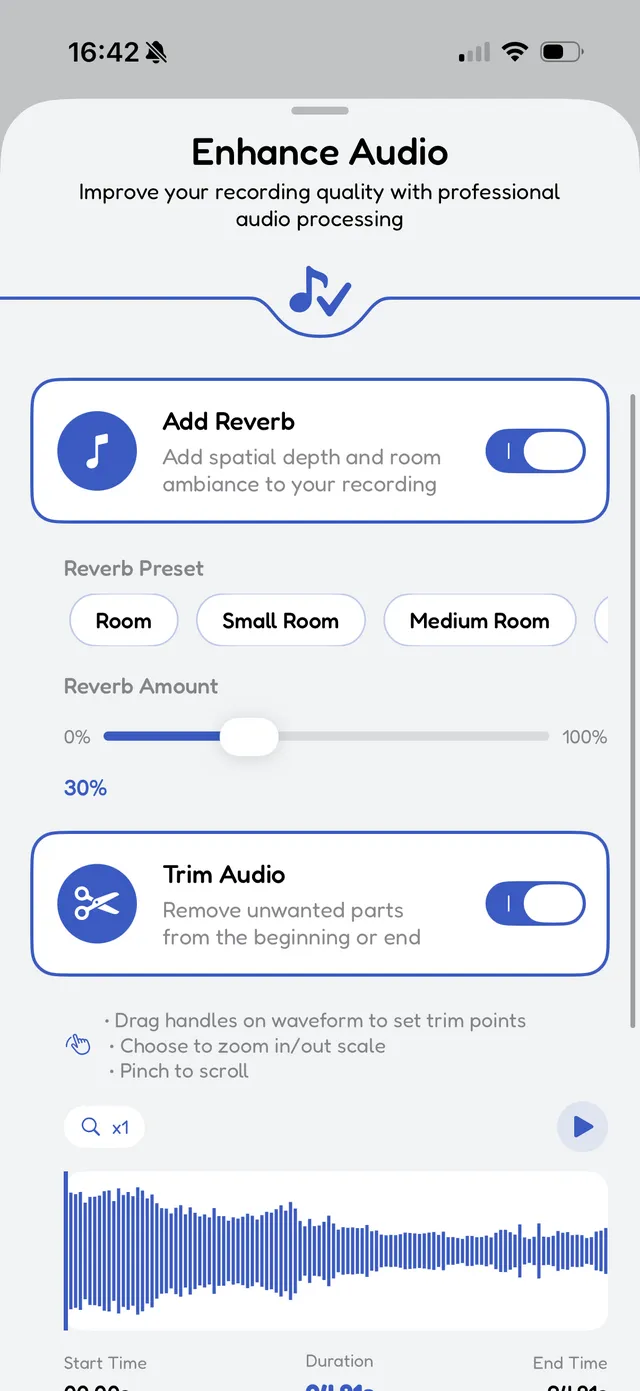
Enhance Audio in Go Practice Music: reverb from Room to Plate, plus waveform trimming with draggable handles.
Your takes live in a searchable recordings library alongside your practice timer, your streak and your progress dashboard — so the attempt, the feedback and the evidence of improvement all stay in one place. Want to see the flow before you try it? The Practice & recording video tour on our homepage walks through it in about two minutes.
Frequently asked questions
How often should I record?
Once a week changes how you practice; more is optional. Record an honest run-through, listen the same day, and write down the one thing to fix tomorrow.
Why do I sound worse on recordings?
You sound accurate. While playing, your attention is too busy to listen like an audience, so your brain flatters you. The discomfort fades with a few weeks of regular listening — the sharper ear it leaves behind is permanent.
Do I need professional gear?
No. A phone microphone reveals rhythm, balance and phrasing — where nearly all improvement lives. The phone on your music stand is the right tool.
Hear yourself improve
One-tap recording, a searchable library of takes, reverb and trimming — built into your practice flow, free to download.
Free to download · iPhone, iPad & Android